What an Inventory Management System Actually Does (And When You Need One)
An inventory management system removes hours, not features
Singapore SMEs rarely have a stock problem. They have a headcount problem that stock created: people paid monthly to retype, chase, and reconcile information that does not move on its own. Five capabilities decide whether software is worth buying.
The question that matters
How many hours a week does your team spend moving stock information between systems, and what would those hours be worth doing something else?
No. 01, Visibility
One item, five places at once
Stock sits at the 3PL, on consignment, in transit, quarantined. A real system distinguishes on hand, available, committed, incoming, in transit, and blocked. A single quantity field will lie to you the first busy week.
No. 02, Traceability
Batch, expiry, serial numbers
For anything with a shelf life, quantity-only tracking is a compliance risk. The recall test settles it: name a contaminated batch and list every customer who received it. If that takes more than a minute, you have a filing cabinet.
No. 03, Tax events
Stock movement is also a tax event
A delivery order should become an invoice without retyping. With GST at 9% and InvoiceNow phasing in for GST-registered businesses, the gap between warehouse and finance is where margin quietly disappears.
No. 04, Purchasing
Landed cost is the number that matters
If the system records the supplier price as your cost, every margin report is wrong. Landed cost absorbs freight, duty, clearance, handling, insurance. Reorder logic must survive lead times measured in weeks and Chinese New Year shutdowns.
No. 05, Accuracy
Cycle counts beat the annual stock take
Count a small subset every week on rotation. Count fast movers and high-value items more often. Investigate discrepancies while the cause is still traceable. Trigger an immediate count when a pick fails. You will still do a year-end count for the financials, but you will not discover anything during it.
Funding in Singapore
Before you sign
Apply for grants before any payment or signed contract. Retrospective applications are rejected. Custom builds cannot use PSG. Most SMEs are honestly served by off-the-shelf for the first few years, and outgrow it in a specific, identifiable way.
Questions to ask any vendor
- Show me one item in three locations and what is available to sell right now.
- Batch 4417 is contaminated. Show me every customer who received it.
- Turn this delivery order into a compliant tax invoice without retyping anything.
- Show me landed cost on a shipment with freight and duty apportioned.
- Show me inventory accuracy as a trend, not a snapshot.
- A customer returns three units, one damaged. Walk me through it.
- Show me all of that on a phone, in the warehouse, on bad wifi.
If a vendor answers the first three on live data, they are worth a second meeting. If they answer with a roadmap, they are not.
A cheaper system that needs one more admin is not cheaper.
Why Stock Becomes a Headcount Problem
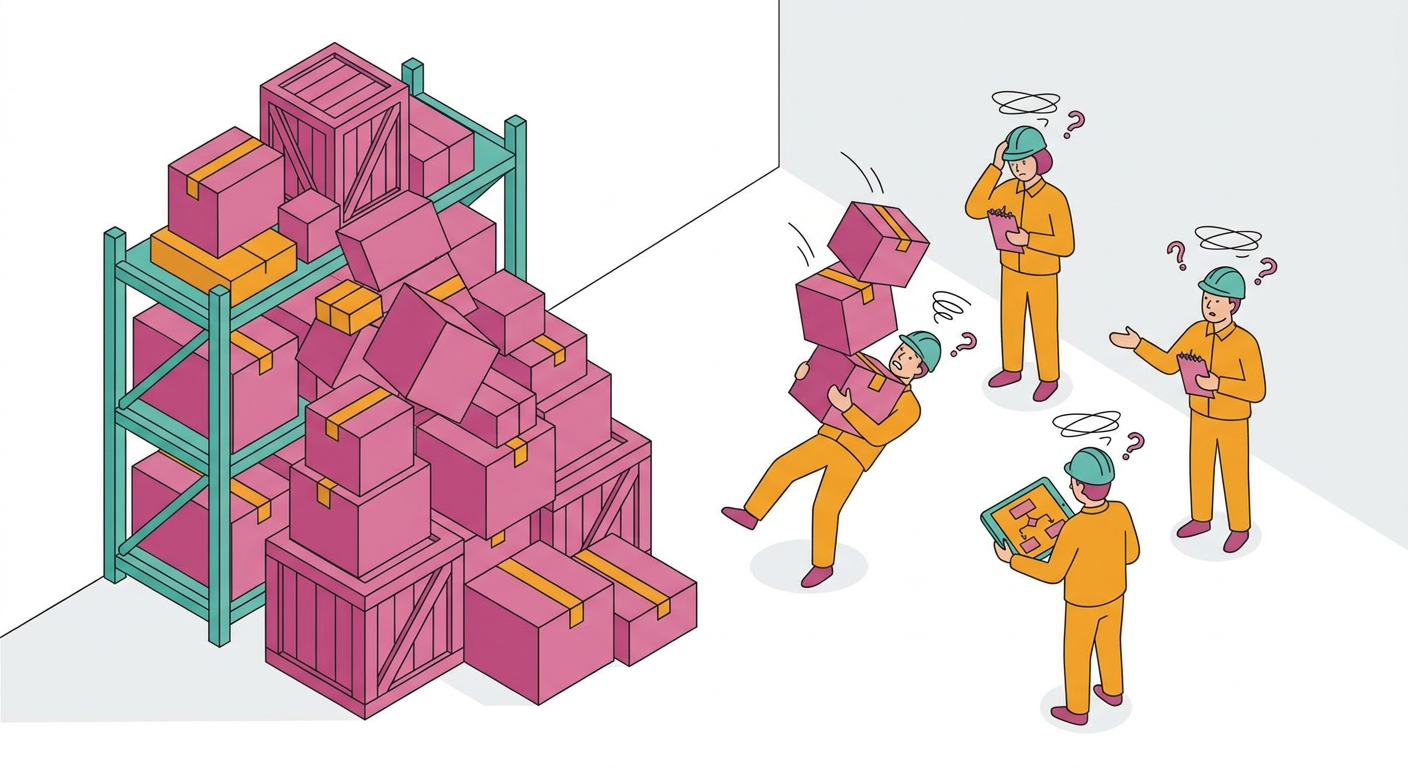
Most Singapore SMEs do not have a stock problem. They have a headcount problem that stock created. Nobody decided to hire a person to retype delivery orders into a spreadsheet, or to walk to a shelf to answer "do we have this?" — those jobs accumulated, one workaround at a time, until they became somebody's week.
Inventory software is usually sold on features: SKUs, barcodes, dashboards. That is the wrong frame for deciding whether to buy it. The right frame is how many hours a week disappear into moving stock information between systems, and what those hours would be worth spent on customers instead.
This guide covers what an inventory management system actually does, the five capabilities that matter in a Singapore context, what it costs, and how to tell a real system from a well-designed demo. If you already know you need one and want the commercial detail, our inventory management software Singapore page covers options, pricing and grants.
The Question That Actually Matters
Vendors will ask how many SKUs you carry. That is the wrong opening question. The question that decides whether software is worth buying is this one:
How many hours a week does your team spend moving stock information between systems, and what would those hours be worth doing something else?
Count them honestly. In most Singapore SMEs the list looks like this:
- Someone types a purchase order into a supplier's portal, then types it again into a spreadsheet.
- Someone checks a WhatsApp photo of a delivery order against a printed PO.
- Someone updates a stock sheet at the end of the day, from memory or from a pile of chits.
- Someone answers "do we have this in stock?" by walking to the shelf.
- Someone reconciles what the warehouse says against what accounting says, monthly.
- Someone rebuilds the same report every week because last week's is already wrong.
- Someone chases a customer's order status because nobody can see it without asking the store.
- Someone writes off stock at year end that has been dead for eleven months.
Each of those is a person. Not a feature gap — a person, paid monthly, doing work that exists only because information does not move on its own. That is the number to put against the price of a system. If you already know you need one and want the commercial detail, our inventory management software Singapore page covers options, pricing shape and grants.
The rest of this guide is about which capabilities actually remove those hours in a Singapore context, and which ones only look impressive in a demo.

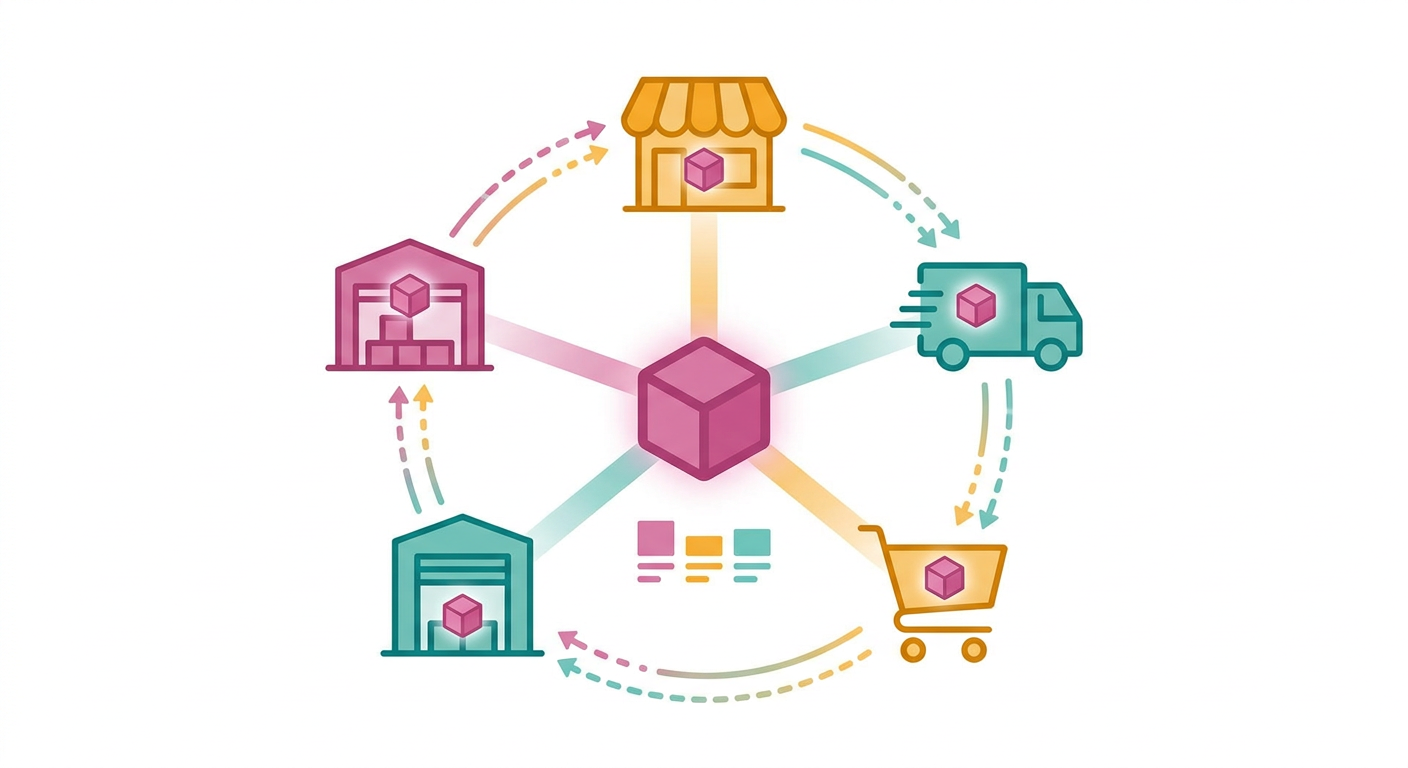
1. One Item Can Be In Five Places At Once
Singapore SMEs rarely hold stock in one building. A typical distributor has stock:
- in their own unit, often an industrial building with limited space
- at a third-party logistics provider, billed by pallet and by movement
- on consignment with a retailer, still legally theirs until sold
- in transit, paid for but not landed
- with a customer on trial, demo or sale-or-return
- reserved against a confirmed order but not yet picked
- quarantined pending a quality check or a damaged-goods claim
Spreadsheets collapse here, because a spreadsheet has one number per item. If most of your stock sits in one facility with racking and pick paths, the problem is closer to warehouse management than inventory control. A real system distinguishes:
- On hand — physically present, wherever it sits
- Available — on hand minus what is already promised
- Committed — allocated to a specific order
- Incoming — on a purchase order, with an expected date
- In transit — shipped between your own locations
- Blocked — present but not sellable
If a system shows you a single "quantity" field, it will lie to you the first week you get busy. The symptom is familiar: you sell something you do not have, or you refuse an order for something you do.
What to test in a demo
- Create a sales order for stock held at the 3PL. Does availability drop immediately?
- Move ten units from the 3PL to your unit. Is it in transit, and for how long?
- Sell one unit of consignment stock at a retailer. Does it reduce your inventory and raise an invoice?
- Reserve stock for a quote that has not been accepted. Can you, and does it expire?
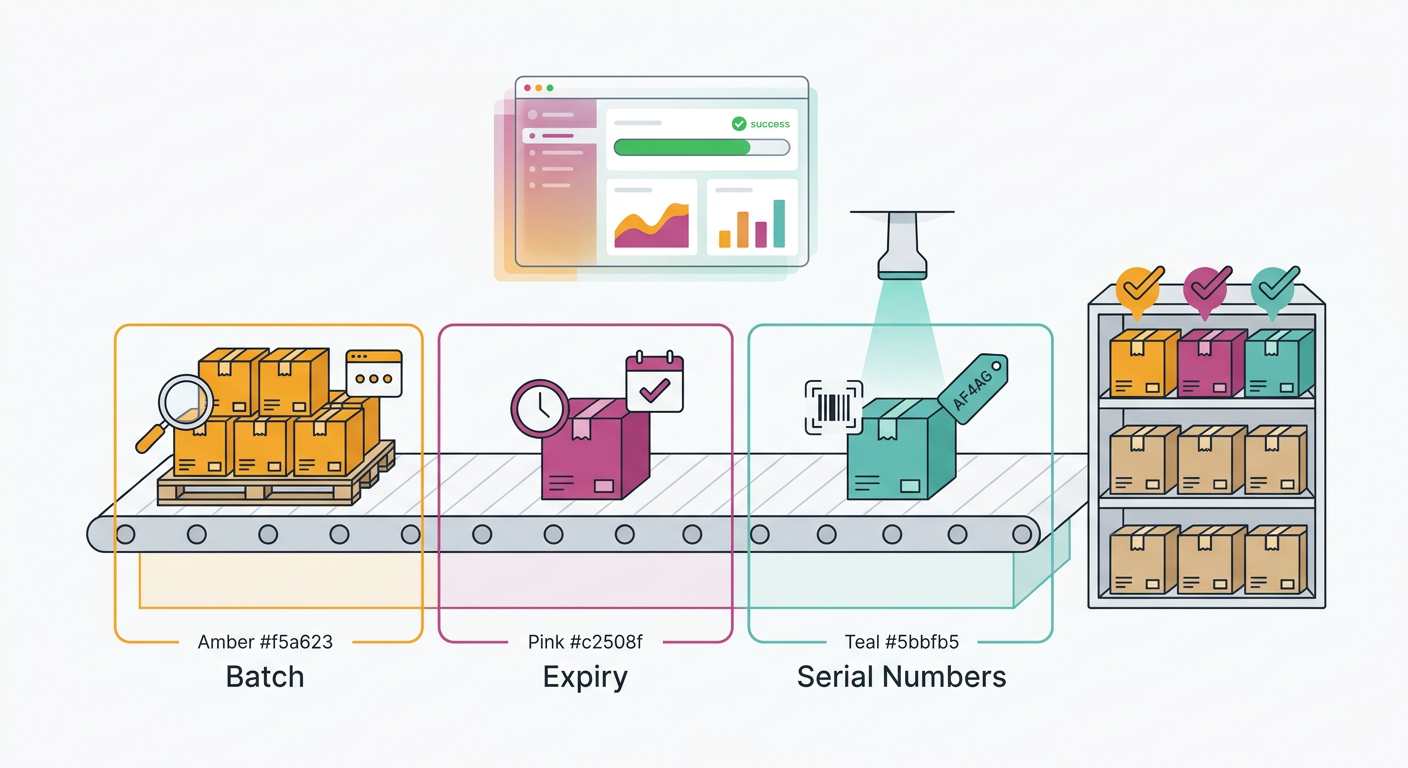
2. Batch, Expiry and Serial Numbers Are Not Optional
If you handle food, beverage, supplements, cosmetics, medical supply or anything with a shelf life, quantity-only tracking is a compliance risk, not just an inconvenience.
The capabilities that matter:
- Batch or lot numbers captured at receipt, not invented later
- Expiry dates per batch, with automatic FEFO (first expired, first out) picking
- Serial numbers for equipment, so warranty and service history follow the unit
- Recall traceability — from one batch number, list every customer who received it
- Shelf-life rules so you do not ship something arriving at a customer with two weeks left
- Quarantine status for stock pending inspection
- Certificate of analysis or supplier documentation attached to the batch
The recall test is the one that separates real systems from spreadsheets with a nice interface. Ask a vendor: "Batch 4417 is contaminated. Show me every customer who received it and every unit still on my shelves." If that takes more than a minute, you do not have traceability — you have a filing cabinet.
This is the capability behind Pacific MediHub, where B2B healthcare supply makes batch discipline non-negotiable.
3. Stock Movement Is Also a Tax Event
In Singapore the gap between "the warehouse says it shipped" and "finance raised an invoice" is where margin quietly disappears. Two things make this sharper than it used to be:
- GST at 9% means a mis-stated invoice is a materially larger error than it was a few years ago.
- InvoiceNow, Singapore's Peppol-based e-invoicing network, is being phased in for GST-registered businesses. The direction is one-way: structured, machine-readable invoices transmitted over a network rather than a PDF attached to an email. Check IRAS for the wave that applies to your business, since the thresholds and dates are staged.
What that means practically for inventory software:
- A delivery order must be able to become an invoice without retyping.
- Tax codes belong on the item, not in someone's head.
- Credit notes for returns must reverse both the stock and the tax.
- Partial deliveries need partial invoicing, cleanly.
- The system should be able to emit a structured e-invoice, or hand off to something that can.
- Every document needs an audit trail: who changed what, when, and from what value.
If your inventory system and your accounting system are strangers, you have just re-hired the person whose job the software was supposed to remove. This is the argument for keeping stock and finance in one ERP rather than two systems and a reconciliation habit.
4. Purchasing Is Where Singapore Importers Actually Bleed
Most inventory advice is written for markets where replenishment takes days. Singapore SMEs import, and that changes the maths entirely.
Your reorder logic has to survive:
- lead times measured in weeks, sometimes months
- minimum order quantities that force over-buying
- container economics — it is cheaper per unit to fill the container, and more expensive to hold it
- partial shipments against one purchase order
- supplier price changes between order and receipt
- freight, duty and handling that belong in landed cost, not in a separate expense line
- currency movement between order and payment
- Chinese New Year and other factory shutdowns that make a six-week lead time a ten-week one
Landed cost is the number that matters
If your system records the supplier price as your cost, every margin report you produce is wrong. Landed cost should absorb:
- the supplier invoice
- freight, apportioned across the shipment
- duty and clearance charges
- inland transport and handling
- insurance
- any inspection or certification cost
Apportioned by value or by weight, consistently, so that a report showing 32% gross margin is actually 32%.
Reorder points that account for reality
- Reorder point = average daily usage × lead time in days, plus safety stock.
- Safety stock should reflect how variable demand is, not just how large it is.
- Seasonality needs a manual override — no algorithm knows your trade show calendar.
- Slow movers need a different rule from fast movers, or you will tie up cash in the wrong SKUs.
5. Accuracy: Cycle Counts Beat the Annual Stock Take
The annual stock take is a Singapore SME ritual: close on a Saturday, count everything, argue about discrepancies, write off the difference, and carry on. It is expensive, disruptive, and it tells you about accuracy once a year — far too late to act on it.
Cycle counting replaces it with something continuous:
- Count a small subset of items every week, on a rotation.
- Count fast-moving and high-value items more often than slow, cheap ones (ABC classification).
- Investigate discrepancies while the cause is still traceable, not eleven months later.
- Track accuracy as a percentage over time, so you can see whether it is improving.
- Trigger an immediate count when a pick fails — the best moment to catch an error is when it surfaces.
You will still do a year-end count for your financial statements. But you will not discover anything during it, which is the point.
Where discrepancies actually come from
- Receiving quantities entered from the PO rather than counted at the door.
- Picks completed on paper and entered in a batch later, or not at all.
- Samples and staff purchases that leave without a transaction.
- Damaged stock removed from the shelf but never written off.
- Returns put back on the shelf without being received.
- Units of measure confusion — a carton counted as a piece.
- Two SKUs that look identical and are stored next to each other.
Notice that almost none of those are software failures. They are process failures that software can either catch or hide. Choose one that catches them.

Off-the-Shelf or Custom?
This is the decision most guides dodge. Here is the honest version.
Choose Off-the-Shelf When
- Your process is genuinely standard: buy, store, pick, ship, invoice.
- You can change how you work to match the software, and you actually will.
- You need it running in weeks, not months.
- Your volumes are predictable and your SKU count is stable.
- You want PSG funding, which requires a pre-approved packaged solution.
- Nobody in the business says "but we do it differently because…" more than twice.
Choose Custom When
- Your process is the competitive advantage and standardising it would cost you customers.
- You have hit the ceiling of an off-the-shelf tool and are paying people to work around it.
- You need it to speak to something bespoke — a customer portal, a production line, a legacy database.
- Your industry has rules the generic tools ignore (consignment, sale-or-return, kitting, made-to-order).
- Per-user licensing has become more expensive than owning the thing.
- You want AI in the workflow itself, not as a chat window bolted on the side.
The same trade-off shows up in every vertical we build for — see how it plays out in construction, where the standard tools simply do not model progress claims. Most Singapore SMEs are honestly served by off-the-shelf for the first few years, and outgrow it in a specific, identifiable way — usually consignment, kitting, or a customer-facing portal. The failure mode is not choosing wrong at the start. It is staying after the workarounds have quietly become three people’s jobs. When that point arrives, a custom build or an AI-native ERP becomes the cheaper option, not the extravagant one.
Funding note
PSG: up to 50% of qualifying costs, capped at S$30,000 per company per year, pre-approved packaged solutions only. EDG: up to 50% for local SMEs, no pre-approved vendor list, covers consultancy and manpower. Custom builds cannot use PSG. Apply before any payment or signed contract — retrospective applications are rejected.
What It Costs
Ranges, not promises. Verify against quotes.
| Approach | Typical shape | Watch for |
|---|---|---|
| Entry SaaS | Per user, per month | Cost scales with headcount even when usage does not |
| Mid-market ERP module | Licence + implementation | Implementation often exceeds the licence in year one |
| Custom build | Fixed project, then hosting | Scope discipline; you own it afterwards |
The comparison that matters is not licence-versus-licence. It is total cost including the people. A cheaper system that needs one more admin is not cheaper.
Questions to Ask Any Vendor
- Show me one item that exists in three locations, and tell me what is available to sell right now.
- Batch 4417 is contaminated. Show me every customer who received it.
- Turn this delivery order into a compliant tax invoice without retyping anything.
- Show me landed cost on a shipment with freight and duty apportioned.
- Show me stock reserved against quotes that were never accepted.
- Show me inventory accuracy as a trend, not a snapshot.
- A customer returns three units, one damaged. Walk me through it.
- Show me all of that on a phone, in the warehouse, on bad wifi.
If a vendor answers questions one to three on live data, they are worth a second meeting. If they answer with a roadmap, they are not.
Signs You Have Outgrown Spreadsheets
Not a sales checklist. These are the specific failures that show up first, in roughly the order they appear:
- Two people have different versions of the stock sheet and both are in use.
- You keep a separate file for "actual" stock because the main one is not trusted.
- Someone has to be in the office for the business to answer a stock question.
- You have sold something you did not have, more than once, in a quarter.
- Purchase decisions are made from memory rather than from a reorder report.
- Month-end reconciliation takes more than half a day.
- You cannot answer "what is this customer's order history" without opening three files.
- Your year-end write-off surprised you.
- A staff member leaving would take real operational knowledge with them.
- You have stopped running certain reports because they are always wrong.
One or two of these is normal. Five or more and the spreadsheet is no longer saving you money — it is costing you a salary.
The Data Work Nobody Warns You About
Implementation delays are almost never the software. They are the item master. Before any system can help you, this has to be true:
SKU hygiene
- One code per item, used consistently by everyone.
- No duplicates created because someone could not find the original.
- Codes that mean something, or codes that mean nothing — but not a mix of both.
- Obsolete items marked obsolete rather than silently abandoned.
- Variants (size, colour, pack) modelled as variants, not as unrelated items.
Units of measure
- A defined base unit per item, and conversions to every unit you buy or sell in.
- Purchase unit, stock unit and sales unit explicitly mapped — carton to inner to piece.
- Weight or volume captured where freight is charged on it.
- No item where "1" is ambiguous.
Opening balances
- A physical count at cutover, not a copy of last month's file.
- Costs that match what accounting will recognise.
- Open purchase orders and open sales orders carried across deliberately.
- A frozen cutover date everyone agrees on.
Budget real time for this. It is the difference between a system that people trust in week three and one they quietly stop using in month two.
What to Check Before You Sign
Beyond the demo, these are the commercial and technical questions that decide whether you regret it:
- Data export. Can you get your own data out, in full, without paying for the privilege?
- API access. Is it available on your tier, or three tiers up?
- User licensing. Does a warehouse picker cost the same as a finance controller?
- Mobile. Is it a real app or a shrunken desktop page?
- Offline. What happens in a basement store with no signal?
- Support hours. In your timezone, or someone else's?
- Implementation. Included, or a separate quote you have not seen yet?
- Roadmap dependency. Are you buying what exists, or what is promised?
- Exit. If you leave in two years, what does that cost and how long does it take?
Frequently Asked Questions
Do I need inventory software if I only have a few hundred SKUs?
SKU count is the wrong trigger. The trigger is how many places stock exists and how many people need to know about it. Two hundred SKUs across four locations with three people asking "do we have it?" is a stronger case than two thousand SKUs in one room with one person who knows.
Can I just use my accounting software?
Up to a point, and that point is usually consignment, batch tracking, or multi-location. Accounting packages model stock as a value. Operations need it as a physical thing in a place with a status. When those two definitions diverge, you get the monthly reconciliation meeting.
Will this let me reduce headcount?
It lets you stop adding headcount, which is usually the real question. The hours it removes are the retyping, chasing and reconciling. Whether that becomes a smaller team or the same team doing more valuable work is your call, not the software's.
How long does implementation take?
The software is rarely the long pole. Cleaning your item master is. Expect the data work — consistent SKU codes, units of measure, supplier records, opening balances — to take longer than the configuration.
Where does this sit against a full ERP?
Inventory is one module of an ERP. If quoting, invoicing, purchasing and stock all live in separate tools today, look at inventory as part of a connected system rather than buying a point solution you will integrate later.
Can I get a grant for it?
PSG covers pre-approved packaged solutions up to 50% and capped at S$30,000 per company per year. EDG can cover custom work at up to 50% for local SMEs. Apply before you pay or sign.