Do You Actually Need a Warehouse Management System?
Do You Actually Need a Warehouse Management System?
The cost of moving goods inside the building is itself significant.
- Pickers walk far enough that the route matters
- Same SKU lives in several locations
- Batch, lot, or expiry drives picking order
- Serial numbers captured at pick, not later
- Volume requires scheduled wave picking
- Inbound and outbound congestion needs sequencing
Your problem is accuracy or process, not movement.
- One room, one or two pickers who know the space
- Stock doesn't tally, but movements are simple
- The system is updated hours after goods move
- Reorganising shelves would solve the issue for free
- Poor accuracy in a single-room warehouse
What a Real WMS Actually Does
Bin-Level Location
Aisle, rack, shelf, bin, every movement updates exact position.
Directed Putaway
System decides placement by velocity, size, weight, and rules.
Pick Optimisation
Routes are sequenced and grouped into waves for labour savings.
Cycle Counting
Continuous small counts replace the annual full-stocktake shutdown.
Do These Three Things First
- Get an accurate opening count.A WMS built on wrong figures produces confident wrong answers, faster.
- Fix units of measure.Cartons, inners, pieces, define conversions once. This is the top reason systems "don't tally."
- Record movements as they happen.If goods move at 10am but the system learns at 4pm, no software fixes that. Scanning is cheaper than a WMS.
Four Paths in Singapore
WMS Inside Your ERP
Best for: Bin locations and directed picking without full wave planning.
PSG grant · up to 50% · capped S$30k
Dedicated WMS Products
Best for: 3PL operations, high volume, regulatory traceability.
Highest cost · months of implementation
Barcode & Scanning Layer
Best for: When the real problem is late, manual recording.
Start here · fraction of WMS cost
Custom-Built Operations
Best for: Non-standard handling, rental fleets, kitting, billing by volume.
From S$3,500 · EDG grant eligible
Most companies asking for a WMS have an inventory problem a WMS won't fix. Do the three steps first, many discover they no longer need one.
Most Companies Asking for a WMS Do Not Need One
That is not a sales position, it is the most common finding when we look at the actual operation. A warehouse management system is expensive, process-heavy and disruptive to adopt, and a large share of the businesses shopping for one have an inventory accuracy problem that a WMS will not fix.
So this guide starts with the dividing line, then covers what a real WMS does, then what it costs in Singapore. We build custom operations systems, so where an off-the-shelf WMS is the better answer, it says so.
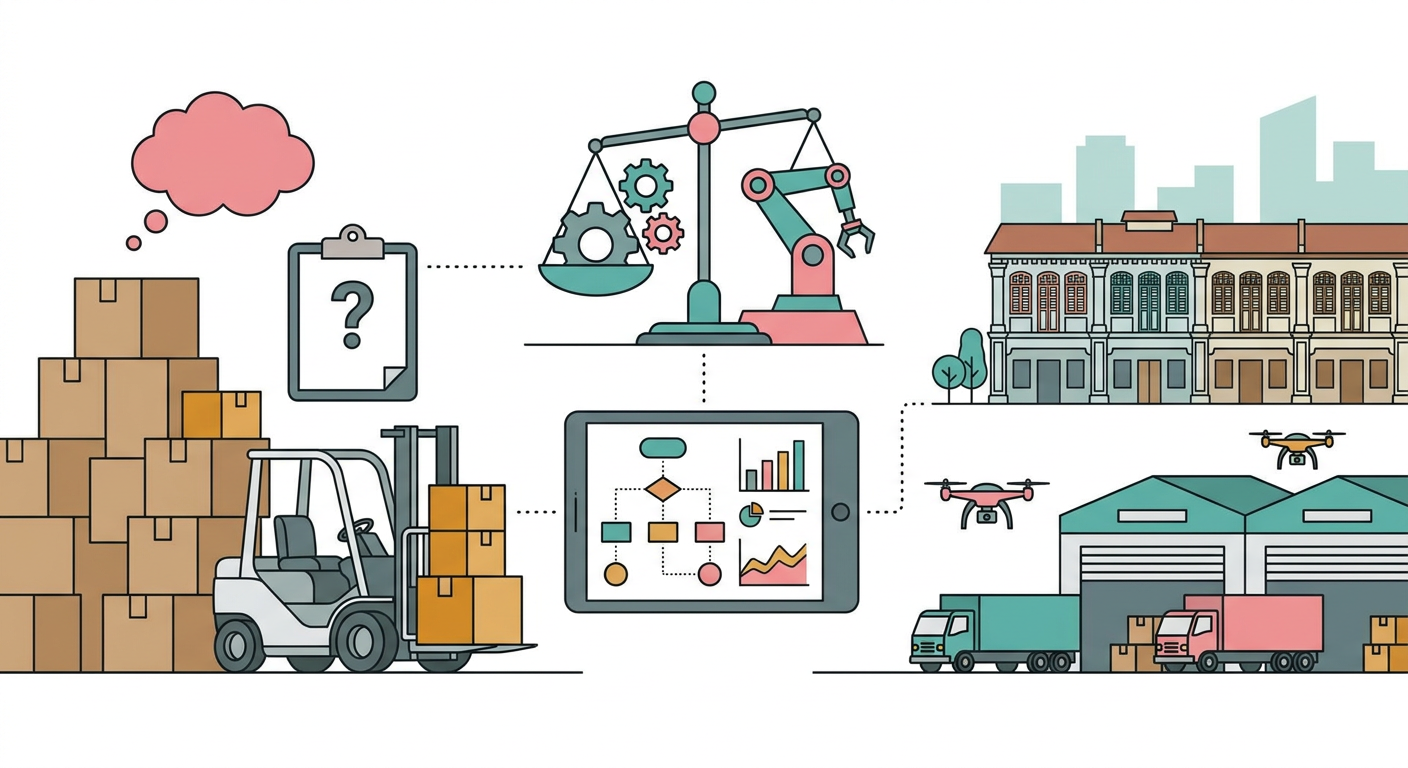
The Dividing Line
Inventory software answers what do I have, and what can I promise. A WMS answers where exactly is it, and what is the most efficient way to move it.
The test is not how much stock you hold. It is whether the cost of moving goods inside the building is itself significant. Concretely, you probably need a WMS when:
- Pickers walk far enough that the route matters. If you can reorganise the shelves and solve it, do that first, it is free.
- The same SKU lives in several places and staff guess which to pick from.
- Batch, lot or expiry drives picking order. FEFO in food, pharma or cosmetics is genuinely hard without system direction.
- Serial numbers must be captured at pick, not reconstructed later.
- Order volume means picking is scheduled work, in waves or batches, rather than order by order.
- You have inbound and outbound congestion that needs sequencing.
And you probably do not need one when: stock accuracy is poor but the warehouse is one room, one or two people pick and they know where everything is, or the real problem is that the system is updated hours after goods move. That last one is a process problem and a WMS will simply automate the delay.
What a Real WMS Does
Location Down to the Bin
Not "Warehouse A" but aisle, rack, shelf, bin. Every movement updates the location, so the system can direct someone to the exact position rather than the general area. This is the foundational difference, and everything below depends on it.
Directed Putaway
On receipt the system decides where goods should go, using velocity, size, weight, temperature or compatibility rules. Fast movers land near despatch, heavy items go low. Done well this quietly removes a large share of picking distance before any picking happens.
Pick Optimisation
The system sequences the pick route rather than following the order line sequence, and groups orders into waves or batches so one trip serves several orders. On a large enough operation this is where the labour saving actually comes from.
Cycle Counting
Continuous counting of small slices by location rather than shutting down for a full stocktake. For most operations this is the single most valuable capability, because accuracy stops being an annual event.
Task Management
Work is assigned and tracked per person: putaway, picks, replenishment, counts. You get throughput per picker and can see where the queue forms. Some teams find this uncomfortable, which is worth surfacing before rollout rather than after.
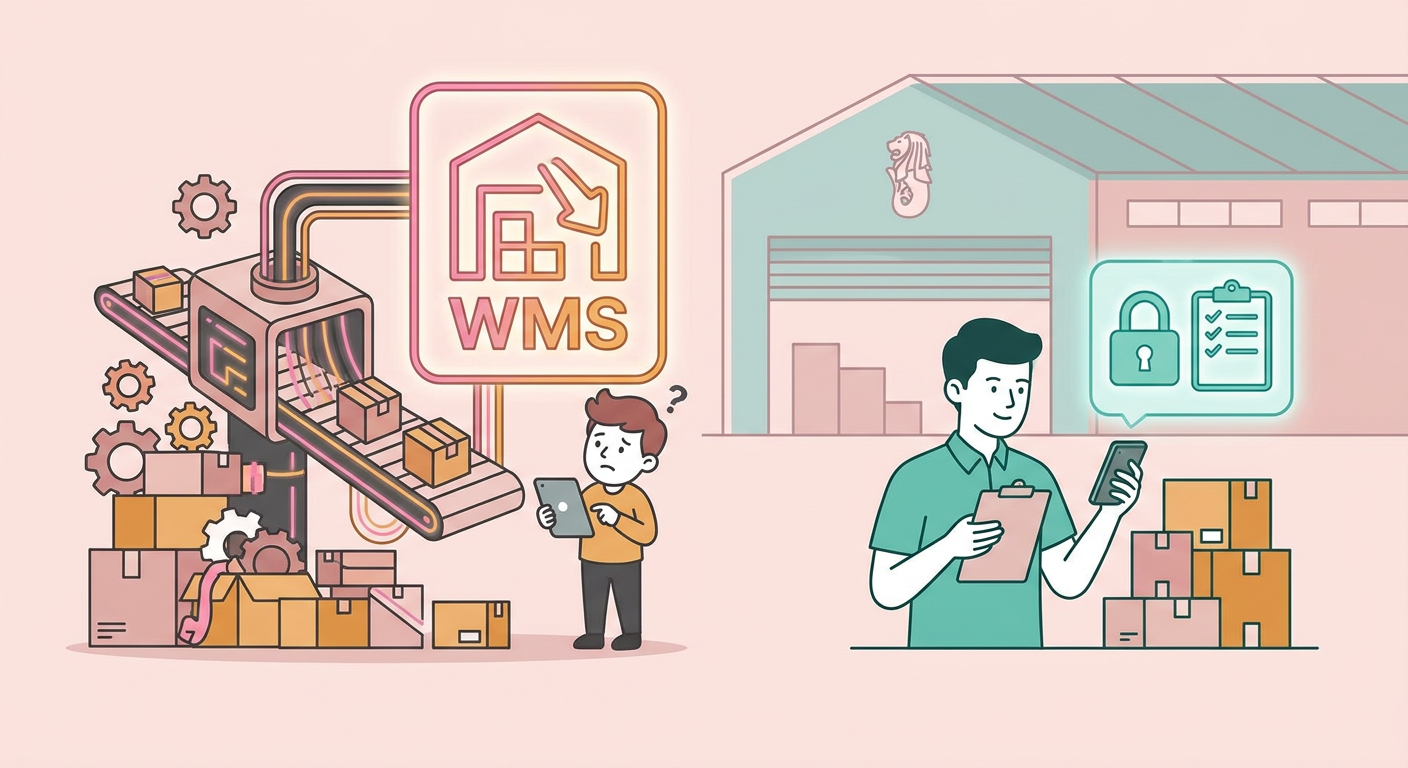
The Options in Singapore
1. WMS Inside Your ERP
Best for: operations that need bin locations and directed picking but not full wave planning, and that already run or are buying an ERP.
SAP Business One, NetSuite, Odoo and the local SG ERP vendors all offer warehouse capability at varying depth. No integration to build or maintain, and stock, finance and orders stay in one system. Packaged ERPs on the IMDA pre-approved list may draw PSG at up to 50% of qualifying costs, capped at S$30,000 per company per financial year. See our ERP comparison.
Source: IMDA Productivity Solutions Grant (PSG) guidelines
Where it loses: depth. ERP warehouse modules typically stop short of real wave planning, slotting optimisation and labour management.
2. Dedicated WMS Products
Best for: genuine third-party logistics operations, high order volume, or regulatory traceability requirements.
Purpose-built systems do everything above properly, and if you are running 3PL you also need billing per client, which only dedicated products handle well.
Where it loses: cost and integration burden. You are now maintaining a join between WMS and finance, and implementation is a project measured in months with real process change.
3. Barcode and Scanning Layer Only
Best for: the very common case where the actual problem is that movements are recorded late and by hand.
Singapore has capable barcode and scanning vendors, and adding scanning to an existing inventory system fixes accuracy at a fraction of WMS cost and disruption. If your stock does not tally and you do not have scanning, start here. Many companies who thought they needed a WMS need this and better discipline.
4. Custom-Built Warehouse Operations
Best for: operations whose handling is genuinely non-standard, where standard WMS assumptions do not hold.
The recurring cases we see: goods that are also assets going out and coming back, such as rental fleets and equipment; storage billed to customers by volume and duration; assembly or kitting where the picked item is not the sold item; and warehouses that are one node in a service workflow rather than a distribution endpoint.
A first working module starts from S$3,500 and typically runs four to eight weeks. Custom is not PSG eligible and goes through EDG instead, which supports up to 50% of qualifying costs for local SMEs. See our EDG guide.
Source: Enterprise Singapore Enterprise Development Grant (EDG) support levels
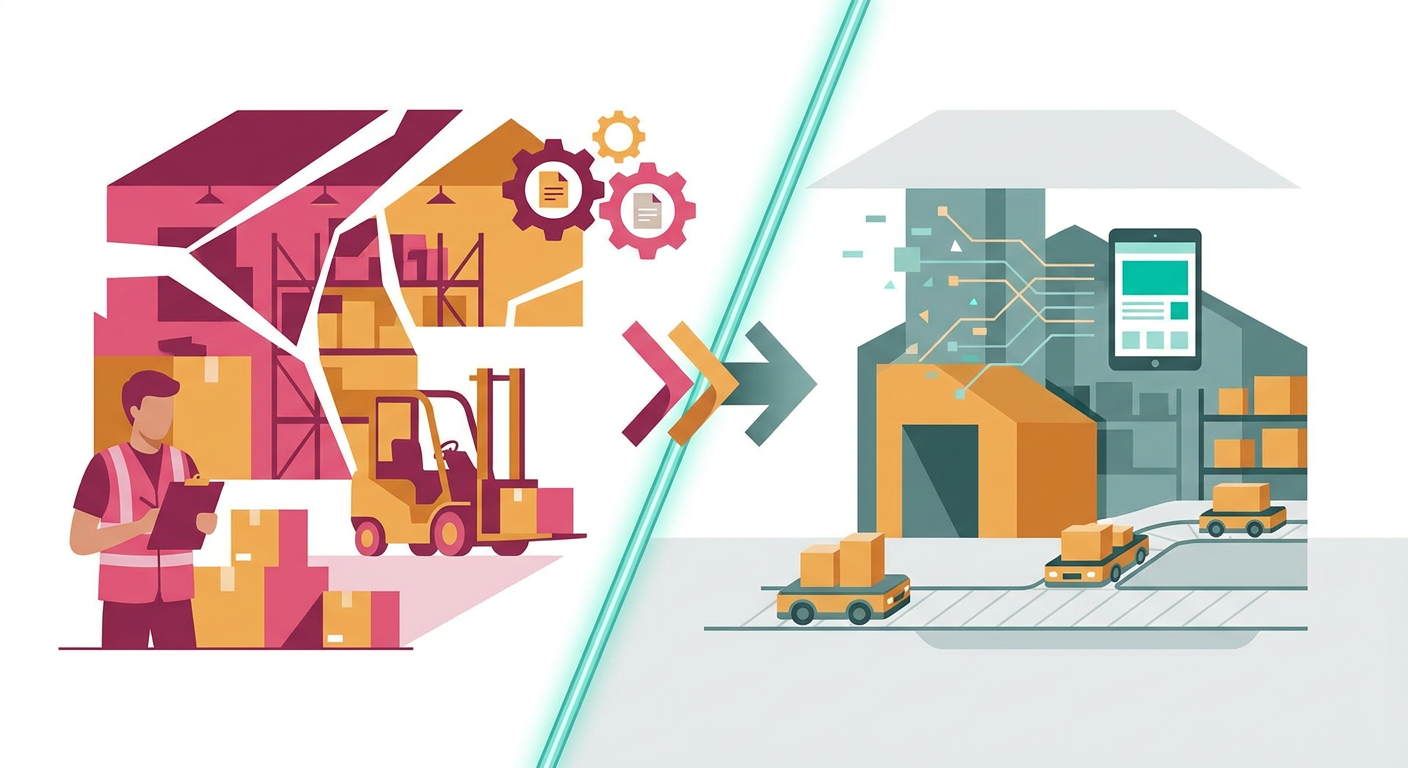
Do These Three Things First
Before any WMS project, in this order:
- Get an accurate opening count. A WMS built on wrong figures produces confident wrong answers, faster.
- Fix units of measure. Buying in cartons, storing in inners, selling in pieces, with conversions defined once. This is the most common reason a warehouse system "does not tally".
- Record movements as they happen. If goods move at 10am and the system learns at 4pm, no software fixes that. Usually the answer is scanning at the point of movement, which is item three above and much cheaper than a WMS.
Do these and a meaningful share of companies discover they no longer need the WMS. That is a good outcome. Our inventory software guide covers the layer beneath.
Questions for Any WMS Demo
- Receive a pallet and show me the system deciding where it goes, and why.
- Pick a four-line order and show the route it chose versus line sequence.
- Batch three orders into one pick trip.
- Pick by expiry date where two batches of the same SKU exist.
- Run a cycle count on one aisle without stopping the warehouse.
- Show throughput per picker for last week.
- Show what the finance system knows after all of that, and when.
If a vendor cannot demonstrate one and two on live data, it is inventory software with location fields, not a WMS. That may still be exactly what you need, but price it accordingly.

Frequently Asked Questions
What is the difference between a WMS and inventory management software?
Inventory software tells you what you have and what you can promise. A WMS directs work inside the building: bin-level locations, directed putaway, optimised pick routes, wave picking and cycle counting. You need a WMS when moving goods around the warehouse is itself a significant cost, not simply when you hold a lot of stock.
Do I need a warehouse management system?
Probably not if you have one room, one or two pickers who know the space, or if your real problem is that movements are recorded hours late. Probably yes if the same SKU sits in multiple locations, expiry or serial capture drives picking, or order volume means picking has to be scheduled in waves.
How much does a WMS cost in Singapore?
Singapore vendors quote per project rather than publishing rates. The larger cost is usually implementation and process change rather than licence, since a WMS changes how the floor works. A custom warehouse module starts from around S$3,500 for a focused first build. Get a three-year total including implementation and support in writing.
Can I get a grant for warehouse management software?
Yes if the solution is on the IMDA pre-approved list, via PSG at up to 50% of qualifying costs capped at S$30,000 per company per financial year. Custom-built systems go through EDG instead. Apply before paying anything to the vendor.
Source: IMDA Productivity Solutions Grant (PSG)
What should I fix before implementing a WMS?
Get an accurate opening count, define units of measure and their conversions once, and record movements at the moment they happen rather than in a later batch. Companies that do these three things often find the WMS is no longer necessary.
Talk It Through
If you are weighing a WMS and want an honest read on whether you need one, we will look at how goods actually move and tell you, including when the answer is scanning and better discipline rather than a system. Get in touch, or see our warehouse management system page.