What a website actually costs in Singapore in 2026
Digital 9 Labs | Singapore 2026
What a website actually costs
A transparent owner-to-owner breakdown of real website pricing across platforms, hosting, maintenance, and the recurring costs agencies often leave out of the quote.
All figures in SGDPlatform pricing tiers
DIY Builder
Wix, ShopifyBest for solo founders and simple storefronts.
WordPress, Custom Theme
CMSBest for SMEs needing content control.
Headless CMS or Custom Build
Laravel, Next.jsBest for high traffic and complex integrations.
A practical budget allocation rule
Design and UX
Visual interface and user journey mapping
Systems integration
Third-party tools and API connections
Post-launch optimization
CRO testing, security, and speed work
Ongoing essentials
Maintenance retainers
Professional maintenance
SGD 100 to SGD 800 per month, depending on platform complexity.
Web hosting, shared
Around SGD 100 to SGD 300 per year for small business sites.
Managed or cloud hosting
SGD 600 to SGD 2,400 per year for SME-grade infrastructure.
Domain name, .com.sg
Typically SGD 60 to SGD 90 per year.
The hidden costs quotes often exclude
Email hosting
Around SGD 10 to SGD 20 per user, per month.
Marketing automation
SGD 50 to SGD 500 monthly, based on contact volume.
Advanced SEO tools
SGD 150 to SGD 400 per month.
Premium plugins
SGD 100 to SGD 500 in annual licensing fees.
PDPA legal fees
SGD 1,500 to SGD 4,000 for tailored terms and privacy policies.
Professional copywriting
SGD 150 to SGD 400 per page.
Custom e-commerce build
SGD 8,000 to SGD 30,000 upfront for payment and inventory work.
Wildcard SSL certificate
SGD 150 to SGD 400 per year. Basic SSL is often free.
A website is never a one-time capital expense. It is an ongoing operational cost.
Digital 9 Labs
If you are planning a digital overhaul, you need to know exactly what a website actually costs in Singapore in 2026. Website pricing changed significantly over the last few years. Agency rates, server infrastructure, and plugin subscriptions all increased. Many Singapore SME owners still operate on 2022 budgets. This creates a massive gap between expectations and reality. We build and maintain secure digital infrastructure at Digital 9 Labs. We wrote this guide to give you a transparent, owner-to-owner breakdown of real website costs. For a broader look at backend business systems, you can visit our main page on ERP software in Singapore.
Website cost components
Every website invoice contains the same core components. Understanding these line items helps you compare quotes accurately. You cannot judge a proposal fairly if you do not know what you are buying.
- Domain name: Your digital address. A
.com.sgdomain typically costs between SGD 60 and SGD 90 per year. Standard.comdomains range from SGD 15 to SGD 50 annually depending on the registrar.
Source: Singapore Network Information Centre (SGNIC)
- Web hosting: This is the server space where your files live. Shared hosting for small business websites commonly ranges from around SGD 100 to SGD 300 per year, while more robust managed hosting or cloud servers for SMEs often sit in the SGD 600 to SGD 2,400 per year range.
Source: Launchbase Asia – Website cost breakdown (2026)
- SSL Certificate: This provides the secure padlock icon. Many hosts provide basic SSL for free via Let's Encrypt. Advanced wildcard SSL certificates cost between SGD 150 and SGD 400 per year.
- Design and UX: The cost of mapping user journeys and creating visual mockups. This is heavily labor-intensive.
- Development: The actual coding work. This turns the design into a live, functioning website.
- Content migration: Moving text, images, and products from an old site to a new site.

Platform types and pricing
The platform you choose dictates your upfront and ongoing costs. There is no single best platform. There is only the best platform for your specific operational needs. We always align platform choices with wider operational workflows. For instance, a retail business needs seamless inventory integration. You can read more about this on our retail operations page.
DIY website builders
Platforms like Wix, Squarespace, and Shopify appeal to bootstrapping founders. They offer low entry costs. However, they restrict customization.
WordPress CMS builds
WordPress remains the most popular content management system. It offers extensive plugin ecosystems. Custom WordPress builds require a capable developer to ensure security and fast loading speeds.
Custom coded web applications
For unique business models, a custom web app built on frameworks like Laravel or Next.js provides total control. These projects carry higher upfront costs but eliminate restrictive monthly platform fees.
| Platform Type | Best For | Upfront Cost Range (SGD) | Annual Cost Range (SGD) |
|---|---|---|---|
| DIY Builder (Wix, Shopify) | Solo founders, simple storefronts | SGD 0 to SGD 1,000 | SGD 400 to SGD 1,200 |
| WordPress (Custom Theme) | SMEs needing content control | SGD 4,000 to SGD 12,000 | SGD 800 to SGD 3,000 |
| Headless CMS or Custom Build | High traffic, complex integrations | SGD 18,000 to SGD 60,000+ | SGD 3,000 to SGD 12,000+ |
Source: MediaPlus – Website development cost in Singapore (2026 guide)
Ongoing maintenance costs
A website is never a one-time capital expense. It is an ongoing operational cost. Treating your website like a static brochure is the fastest way to get hacked or lose search rankings. Maintenance covers several critical security and performance tasks.
- Core updates: Updating the CMS software when new versions are released.
- Plugin and extension updates: Third-party tools require patching to fix security vulnerabilities.
- Server monitoring: Ensuring uptime and optimizing database queries.
- Backup management: Testing automated backups to ensure data restoration works properly.
Expect to pay between SGD 100 and SGD 800 per month for professional maintenance retainers. This depends entirely on the complexity of your platform. A custom Laravel application with payment gateways costs more to maintain than a simple Shopify store.
Source: MarketingAgency.sg – Website maintenance cost ranges (2026)
Hidden costs Singapore businesses miss
Quotes from agencies often exclude crucial third-party tools. You must budget for these recurring software costs separately. When planning your digital ecosystem, these tools must connect to your broader back-office systems. If you need to align these tools with accounting and HR, explore our guide on ERP integration in Singapore.
- Email hosting: Google Workspace or Microsoft 365. Budget around SGD 10 to SGD 20 per user, per month.
Source: Google Workspace – Singapore pricing
- Marketing automation: Tools like HubSpot or Mailchimp. Ranges from SGD 50 to SGD 500 monthly based on contact volume.
- Advanced SEO tools: Ahrefs or SEMrush subscriptions. Expect to pay SGD 150 to SGD 400 per month.
- Premium plugins: Specialized WordPress plugins for booking systems or advanced forms often carry annual licensing fees between SGD 100 and SGD 500.
PDPA compliance and legal fees
Singapore businesses must comply with the Personal Data Protection Act (PDPA). You need legally vetted privacy policies and cookie consent banners. A technology lawyer might charge between SGD 1,500 and SGD 4,000 to draft robust terms of service and privacy policies tailored to data collection.
Professional copywriting
Design agencies rarely include high-quality copywriting in their base proposals. Good copy converts visitors into leads. Hiring a B2B copywriter costs between SGD 150 and SGD 400 per page. You can learn more about structuring these assets correctly in our website architecture guide.
Frequently asked questions
Can I build a website for under SGD 2,000 in Singapore?
Yes, but only if you use a DIY platform like Shopify or Wix and do all the work yourself. If you hire a professional agency or freelancer, a budget under SGD 2,000 will not yield a custom-designed, high-performing website. You will receive a generic template with limited functionality.
How much does an e-commerce website cost in 2026?
A custom e-commerce website with secure payment gateways and inventory management typically costs between SGD 8,000 and SGD 30,000 upfront. The final price depends on the number of products, required shipping integrations, and the complexity of the checkout process.
Source: MediaPlus – E-commerce website cost ranges (2026)
Do I need to pay for web hosting monthly or annually?
Most reputable hosting providers offer both monthly and annual billing cycles. Paying annually usually secures a discount of 10 percent to 20 percent compared to monthly billing. For mission-critical enterprise hosting, annual contracts are standard.
Why do web design agencies charge such different rates?
Agencies base their rates on overhead, expertise, and location. A local Singapore agency with senior developers will charge more than an offshore freelancer. Higher rates reflect project management standards, code quality, security practices, and local legal compliance knowledge. Read more about avoiding low-quality builds in our piece on website vendor red flags.
Is WordPress still cost-effective compared to Shopify?
WordPress (via WooCommerce) is highly cost-effective if you require deep customization or complex B2B functionalities. Shopify is more cost-effective for standard B2C retail stores because the platform handles server maintenance, security patches, and payment gateway updates automatically.

Planning your 2026 website budget
You cannot treat a website as a static digital brochure anymore. In 2026, websites act as the primary integration point between your customers and your internal software stack. Sales data flows from the website into your inventory management system. Leads flow automatically into your CRM.
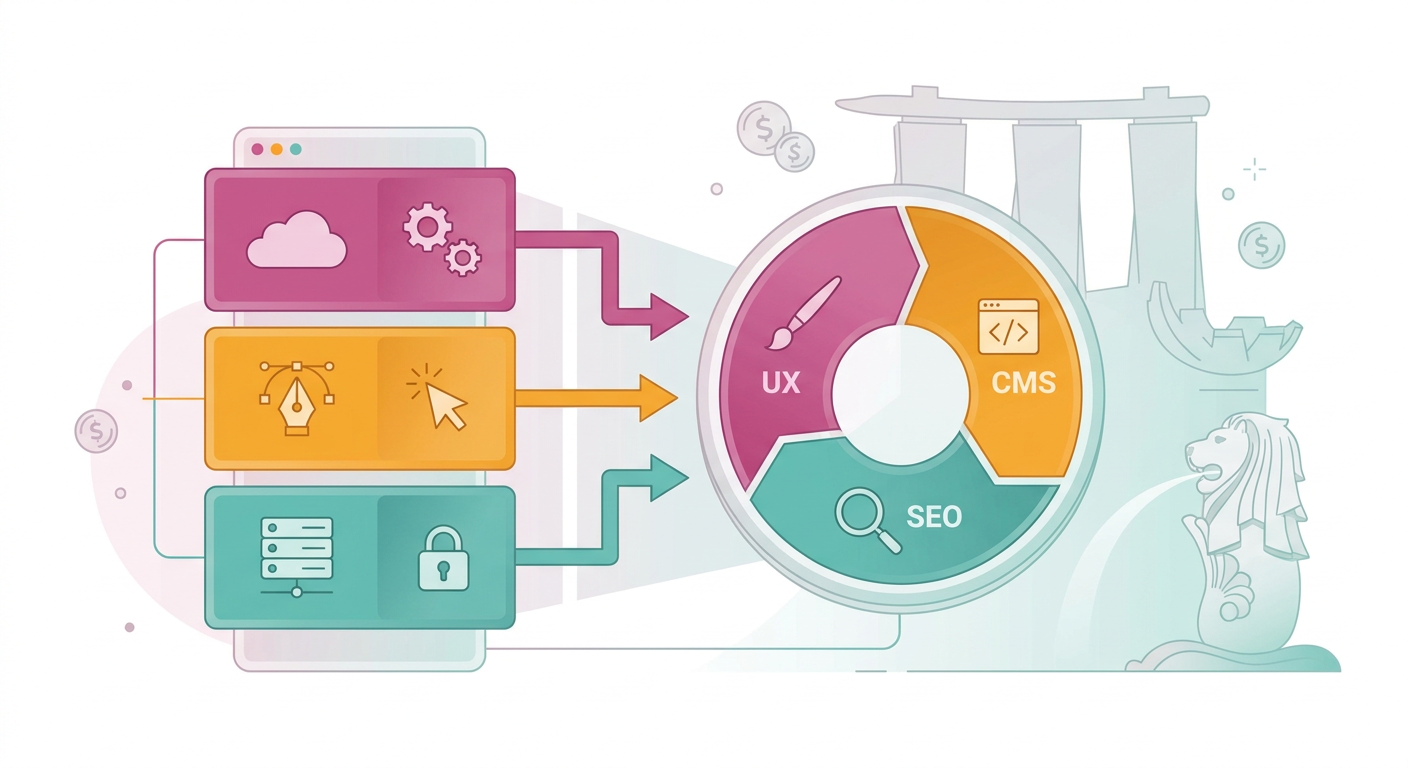
When mapping out your budget, allocate funds across three main pillars. As a practical planning rule, many businesses allocate roughly half of their initial budget to design and development, around one-third to third-party integrations and API connections, and the remainder to a post-launch marketing and optimization retainer.
- Design and UX: The visual interface and user journey mapping.
- Systems integration: Connecting your website securely to your internal business software.
- Post-launch optimization: Ongoing CRO testing, security monitoring, and speed enhancements.
Making the final decision
Selecting the right partner for your website build matters more than the platform itself. A poorly coded custom build will cost you more in lost revenue and emergency developer fees than a well-managed DIY platform. Clarify your operational requirements before you sign any contracts. Understand your customer acquisition strategy before requesting quotes. Need a hand mapping out the software and infrastructure your business actually needs? Let us help you scope the right digital ecosystem. Reach out to the team at Digital 9 Labs today to start a conversation.