Quotation to invoice for dental clinics in Singapore: the manual hours it removes
From quotation to invoice, the hours automation removes
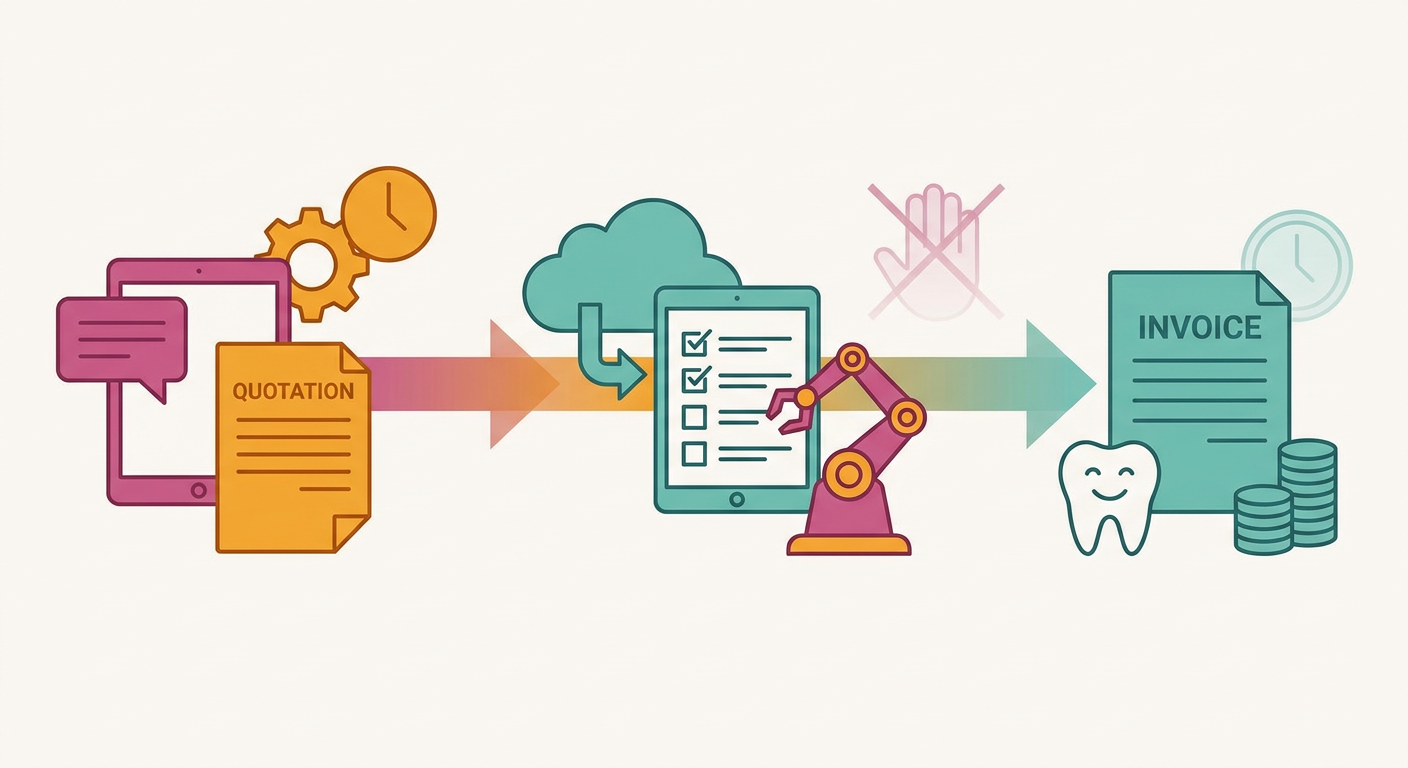
Manual billing fragments a dental practice across word processors, claim portals and paper files. An integrated digital path collapses the same work into minutes per patient.
What changes at the front desk
- 1One click quotation conversion. A treatment plan becomes a formal quotation, then a finalised invoice, without re-typing patient details or codes.
- 2Direct CHAS integration. A patient NRIC swipe confirms the CHAS tier, calculates the subsidy and co-payment, and produces an MOH-compliant invoice.
- 3Private insurer e-claims. The approved quotation converts into a claim, with separate invoices generated for the insurer and patient co-payment.
- 4IRAS-ready tax invoices. The 9 percent GST applies to taxable dental procedures, supporting accurate annual filing.
Running a dental clinic in Singapore means juggling patient care with a mountain of administrative work. One of the most time consuming tasks is managing the billing cycle. Moving from a treatment plan to a quotation, and eventually to an invoice, involves repetitive data entry. When you automate the quotation to invoice for dental clinics in Singapore: the manual hours it removes can transform your daily operations. We examine how integrated software eliminates this busywork, letting your front desk focus on patients rather than paperwork.
If you are evaluating broader systems, our pillar guide on ERP software in Singapore provides a comprehensive overview of what modern automation can do for healthcare businesses.
- The Hidden Administrative Burden in Dental Billing
- Manual Processes Versus Automated Workflows
- Quantifying the Manual Hours Removed
- Core Features That Eliminate Data Entry
- Streamlining CHAS and Insurance Claims
- Choosing the Right Dental Clinic Software
- Frequently Asked Questions
The Hidden Administrative Burden in Dental Billing
In a typical Singapore dental practice, the billing journey is fragmented. A dentist proposes a treatment plan. The front desk staff then types this plan into a word processor or spreadsheet to generate a quotation. The patient reviews it, makes a co-payment, or uses their MediSave.
Later, the clinic must submit a claim to a private insurer or the Community Health Assist Scheme (CHAS). Finally, an invoice is generated and handed to the patient. This sequence involves typing the same patient details, treatment codes, and prices three or four times.
Where Time Gets Wasted
The friction occurs in the handovers. Staff print documents, manually calculate goods and services tax (GST) at the current 9 percent, and chase missing information. These manual touchpoints create delays and introduce human error.
Source: Inland Revenue Authority of Singapore – GST rates
- Redundant Data Entry: Typing patient names, NRICs, and procedures into multiple standalone systems.
- Manual GST Calculation: Calculating the 9 percent GST on standard-rated dental procedures manually on a calculator.
- Claim Form Preparation: Filling out CHAS claim forms separately from your internal clinic invoice.
- Payment Reconciliation: Matching bank transfers from insurers with the correct patient account after a few days.
When these tasks accumulate, your reception area becomes a bottleneck. You can explore our dedicated dental clinic software Singapore page to see how specialised tools address these exact healthcare bottlenecks.
Manual Processes Versus Automated Workflows
To understand the value of automation, compare how a routine procedure like a dental crown is handled manually versus through an automated digital workflow.
The Old Way: Manual and Disconnected
Manual workflows rely heavily on human memory and physical paper. Staff must check patient eligibility by calling insurers. They write down treatment codes, calculate totals, and physically file paper invoices for future auditing by the Ministry of Health (MOH).
The New Way: Integrated Digital Paths
An integrated system links your clinical charting directly to your billing module. When a dentist charts a procedure, the software instantly knows the standard fee. It generates a quotation on the spot. Upon approval, it converts the quotation into an invoice with a single click.
| Process Step | Manual Process Time | Automated Process Time | Friction Points Removed |
|---|---|---|---|
| Treatment Plan Creation | 10 to 15 minutes | 1 to 2 minutes | Auto-population of standard fees and treatment codes |
| Quotation Generation | 5 to 10 minutes | Instantaneous | Automatic application of 9 percent GST and clinic letterhead |
| Claim Submission (CHAS or Private) | 10 to 20 minutes per claim | 2 to 3 minutes | Direct electronic submission and immediate eligibility checks |
| Invoice Generation and Receipting | 5 minutes | Instantaneous | Automatic conversion of approved quotation into a finalised invoice |
| Total Time Per Patient | 30 to 50 minutes | 3 to 5 minutes | Removes up to 45 minutes of manual administrative work |
Source: Denzif – How to cut dental clinic admin time in half (2026 playbook)
By shifting to digital systems, practices save significant amounts of time across scheduling, billing, and claim workflows. Published case studies and playbooks show dental clinics can cut overall administrative time by around 40–50 percent when they automate core front-desk and billing tasks, which aligns with the time reductions illustrated in the table above.
Read our article on inventory management software in Singapore to understand how linking your billing to your dental supplies creates further operational efficiency.
Quantifying the Manual Hours Removed
Let us break down the actual hours saved when a dental practice moves from a manual billing method to an automated quotation to invoice workflow. These numbers illustrate a realistic scenario for small and medium enterprise (SME) healthcare clinics in Singapore.
Daily Time Savings
Consider a moderate flow of 15 patients a day. If your staff spend an average of 40 minutes per patient on manual quotation, claim filing, and invoicing, that totals 10 hours of administrative work daily.
With an automated system reducing this to 5 minutes per patient, the total administrative time drops to 1.25 hours a day. This removes approximately 8.75 hours of manual labour daily. That is the equivalent of hiring one full time administrative staff member solely for data entry.
Monthly Financial Impact
Over a standard 22 day working month, removing 8.75 hours a day yields 192.5 hours saved. This is massive for an SME. It frees up your clinic managers to focus on patient experience, marketing, or handling complex cases that genuinely require human intervention.
- Time saved per week: Approximately 43.75 hours.
- Time saved per month: Roughly 175 to 192.5 hours.
- Annual administrative hours removed: Over 2,000 hours.
Industry data on dental clinic automation indicates that reclaiming dozens of hours of admin time each month is common once core billing and scheduling workflows are digitised. This makes the above scenario a plausible illustration of what a busy multi-chair practice can achieve with integrated quotation-to-invoice automation.
Source: Remedico – Dental office software: streamlining scheduling, billing, records
Real World Application for Dental Practices
For multi chair practices, the saved hours compound quickly. Practices utilising a complete enterprise resource planning setup see a direct reduction in overtime claims by administrative staff.
Core Features That Eliminate Data Entry
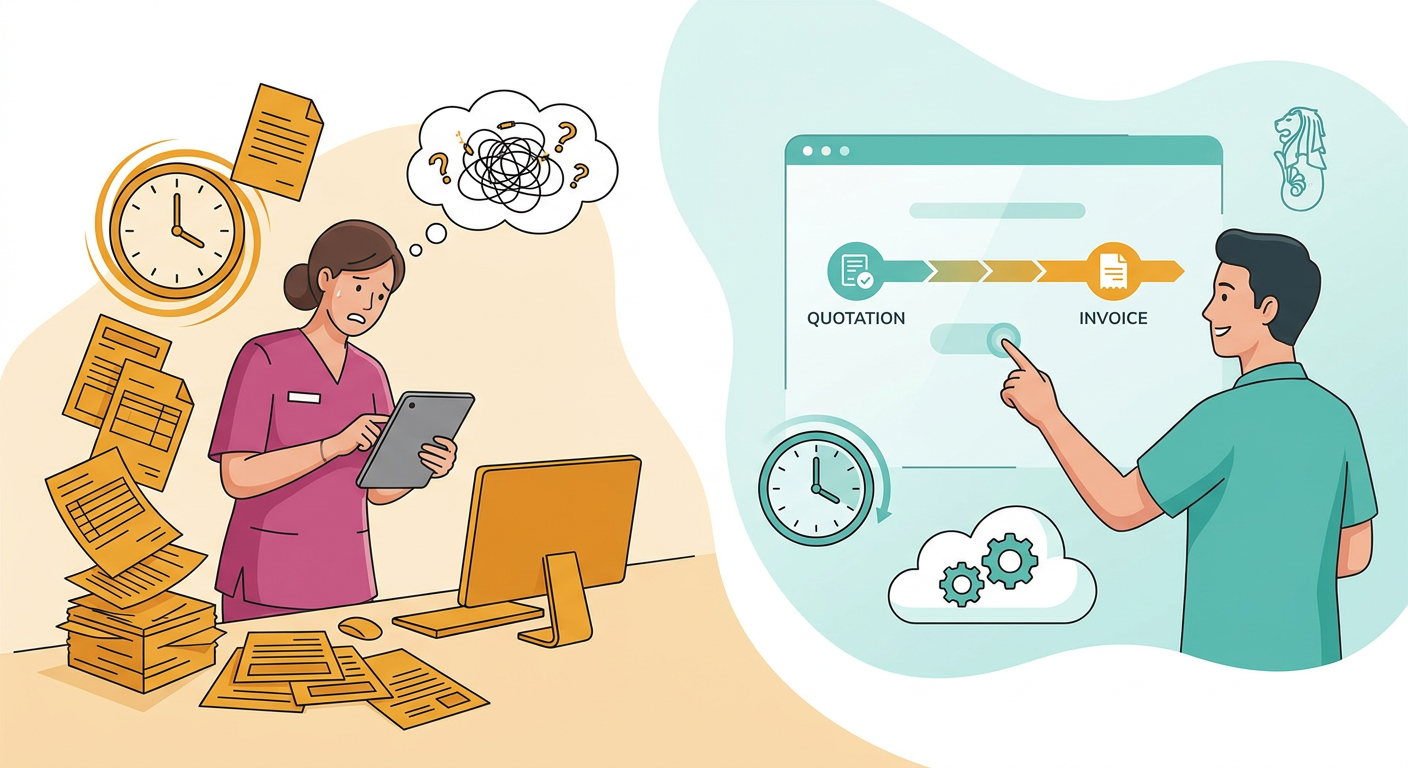
Specific software functions drive these time savings. When selecting a system for your dental practice, look for these exact features that remove manual intervention.
One Click Quotation Conversion
The system should allow you to convert a treatment plan into a formal quotation instantly. The quotation should automatically pull in your clinic logo, address, GST registration number, and patient demographics from the health record.
Once the patient agrees to the treatment, the quotation converts into an invoice without re-typing a single detail. This seamless transition is the core of what makes the quotation to invoice for dental clinics in Singapore: the manual hours it removes so impactful.
Pre populated Item Codes
Your software should maintain a database of procedures. When a dentist types a procedure, the software suggests the exact code and your customised standard fee.
- Automatic charging for standard consumables like local anaesthetic.
- Immediate application of clinic specific discounts for senior citizens.
- Strict enforcement of dual currency display for foreign tourists if required.
Streamlining CHAS and Insurance Claims
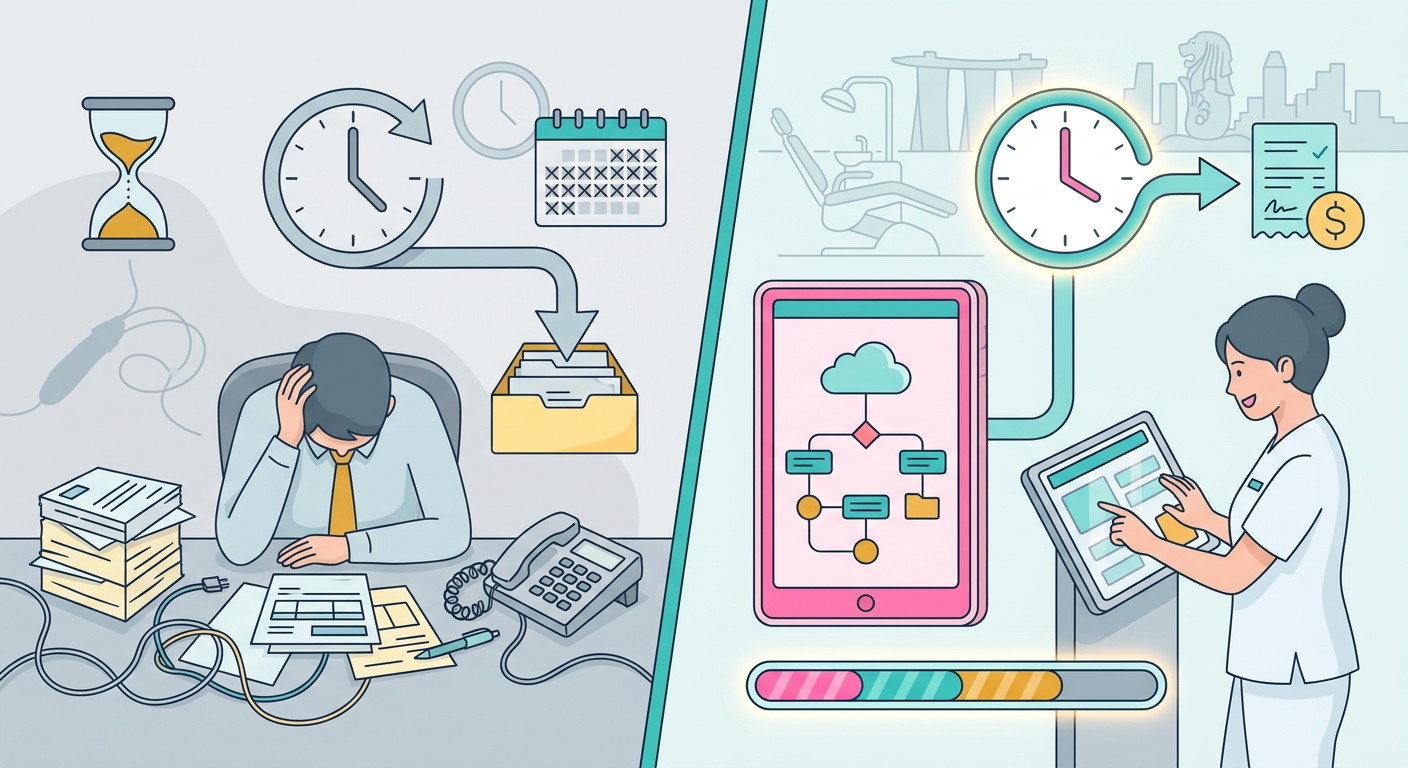
A major source of administrative pain in Singapore is government schemes and private health insurance integration. Manual billing requires staff to log into separate portals to verify a patient.
Modern clinic management software links directly to these databases. For a deeper dive into financial system integration, check out our sibling article on accounting software in Singapore.
Direct CHAS Integration
With direct integration, front desk staff swipe the patient NRIC and the system instantly confirms their CHAS tier, whether it is Blue, Orange, or Green. The system automatically calculates the subsidy amount, the patient co payment, and the final GST.
The invoice generated is fully compliant with MOH audit requirements. This removes the need for manual tracking of CHAS claim limits per patient per year.
Source: Ministry of Health Singapore – Community Health Assist Scheme (CHAS)
Private Insurer E Claims
For private health insurance, integrated systems connect with e claim platforms. The system converts the approved quotation into an insurance claim. If the insurer covers 80 percent of the bill, the system automatically generates two invoices: one to the insurer for their portion, and one to the patient for the co payment.
Choosing the Right Dental Clinic Software
Not all software is built the same. You must ensure the platform you choose fits the specific regulatory environment of Singapore. For more operational insights, you can review our HRMS software in Singapore guide to see how staff rostering ties into clinic profitability.
MOH Compliance and Audit Readiness
Your generated invoices must meet strict criteria for healthcare subsidies. The software must clearly delineate between the gross fee, the CHAS subsidy, the private insurance payout, and the net out of pocket expense for the patient.
Cloud Versus On Premise Systems
Cloud based systems offer a distinct advantage. They allow clinic owners to check daily collections and outstanding invoices from their mobile phones. This flexibility is vital for modern practice management.
Frequently Asked Questions
How does automated invoicing handle Singapore GST regulations?
Automated invoicing systems are configured to the local tax framework. They automatically apply the standard 9 percent GST to taxable dental procedures. The system generates IRAS compliant tax invoices, ensuring your reporting is accurate during the annual filing season.
Source: Inland Revenue Authority of Singapore – GST: charging and tax invoices
Can I customise quotations for different patients?
Yes. Modern software allows you to adjust prices on a case by case basis. You can apply specific discount codes, split payments, or add custom notes. The system retains these customisations when converting the quotation into an invoice.
What happens if a patient disputes a charge on the invoice?
The software maintains a clear audit trail. You can easily pull up the original treatment plan, the signed quotation, and the finalised invoice. This transparency speeds up dispute resolution and maintains trust with your patients.
Is it difficult to migrate from manual records to an automated system?
Migration requires planning but reputable software vendors provide onboarding support. They assist with importing your existing patient database, historical debtors, and standard fee schedules. The short term effort yields long term hours saved.
Next Steps for Your Dental Practice
Removing manual hours from your quotation and invoicing workflow is a straightforward way to boost your clinic profitability. It reduces human error, ensures compliance with Singapore healthcare regulations, and frees your staff to provide better patient care.
At Digital 9 Labs, we help Singapore SMEs implement systems that work seamlessly. If you want to map out a digital workflow tailored to your specific clinic operations, reach out to our team. Let us have a conversation about how we can streamline your practice administration.
Contact Digital 9 Labs today to arrange a workflow consultation.