The real cost of manual job and project costing for dental clinics in Singapore
The real cost of manual costing
Why spreadsheet tracking quietly erodes the margins of dental clinics in Singapore.
Many practice owners know their top-line revenue but cannot explain why the bottom line fluctuates. The answer almost always lies in how costs are tracked, and most clinics only track direct materials, loosely.
Flat-rate averaging
A lab fee that rises from SGD 450 to SGD 480 per crown, tracked at a flat SGD 450, hides SGD 30 per case. Across 50 monthly cases, that is SGD 1,500 in unaccounted costs.
Manual reconciliation
A busy practice can spend 15 to 25 hours a month cross-referencing supplier invoices with patient records and inventory logs. That is significant admin time simply moving data.
Labour treated as overhead
If Dentist A takes 30 minutes and Dentist B takes 50 minutes on the same procedure, margins vary wildly. Untracked chair-time is a direct hit to the bottom line.
Centralise the data
Patient management must talk to inventory. When a dentist uses an anaesthetic cartridge, usage should instantly reflect in cost of goods sold, with no end-of-month scramble.
What this adds up to
- Untracked consumables, mispriced lab fees, and unallocated labour compound into silent revenue leaks.
- Most SME clinics only track direct materials, and usually loosely.
- A dedicated system connects every syringe, implant, and minute of chair time to your bottom line.
Dental clinic owners in Singapore know that running a practice involves far more than patient care. Between managing staff, ordering consumables, and handling compliance, the operational load is heavy. One area that often gets neglected is accurate financial tracking for specific treatments and clinic projects. When you rely on spreadsheets or generic accounting software to track procedure costs, you expose your business to silent revenue leaks. Understanding the real cost of manual job and project costing for dental clinics in Singapore is the first step toward plugging those leaks and protecting your margins.
At Digital 9 Labs, we speak with practice owners daily who are frustrated by unpredictable profit margins. They know their top-line revenue but cannot figure out why their bottom line fluctuates. The answer almost always lies in how they track costs. If you are looking for a broader operational overhaul, our comprehensive guide on ERP software in Singapore is a great starting point. For now, let us dissect the specific financial damage caused by manual job costing in the dental sector.
What is Job Costing in a Dental Context?
Job costing, often referred to as project costing, is the accounting practice of tracking all the specific expenses associated with a single deliverable. In manufacturing, this is straightforward. In dentistry, it is highly complex but entirely necessary. A "job" in a dental clinic could be a full-mouth rehabilitation, a series of Invisalign treatments, or even a facility project like installing a new digital X-ray room.
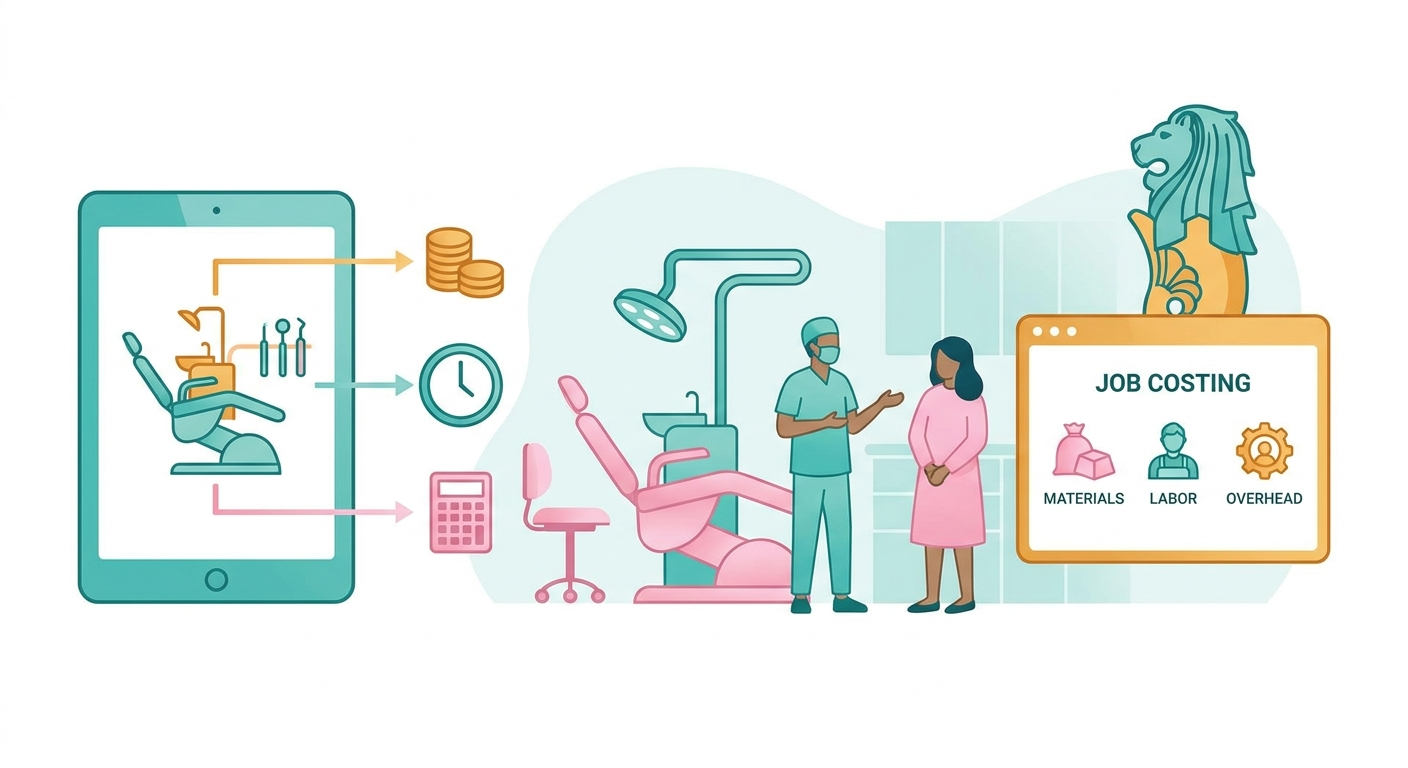
When you calculate the real cost of a dental procedure, you have to aggregate three main categories. Failing to track even one category accurately distorts your profitability.
- Direct Materials: Implants, crowns, abutments, whitening gel, and anaesthesia.
- Direct Labour: The specific time cost of the dentist, dental surgeon, and chairside assistant.
- Overhead Allocation: Clinic rent, equipment depreciation, utility bills, and front desk administration time.
Most Singapore SME clinics only track direct materials, and they usually do this loosely. A clinic manager might tally the monthly invoice from a local dental lab and divide it by the number of crown procedures done that month. This lazy averaging hides the true cost of individual cases. If you want to scale your practice sustainably, check out our detailed breakdown on job costing versus process costing.
The Hidden Financial Drain of Spreadsheet Tracking
Many multi-chair practices still rely on Excel or Google Sheets to track their operational costs. The immediate cost of these tools is low, sometimes even free. However, the long-term financial drain is enormous. The real cost of manual job and project costing for dental clinics in Singapore manifests in several invisible ways that slowly erode your profitability.
Data Entry Errors and Formula Breakdowns
Spreadsheets are inherently fragile. A clinic administrator might accidentally overwrite a formula, duplicate a row, or enter a lab fee in the wrong currency. Research on operational spreadsheets has found that a large majority contain material errors, highlighting how easy it is for inaccuracies to slip into manual models.
The Cost of Manual Reconciliation
Consider the hours your clinic manager spends cross-referencing supplier invoices with patient records and inventory logs. In a busy Singapore practice, this could easily take 15 to 25 hours a month, once you factor in routine billing reconciliation and matching lab work to patient procedures. At typical administrative wage levels in Singapore, this translates into a significant annual cost simply to move data between disconnected systems.

Lab Fees and Consumables: The Margin Killers
Dental consumables and lab fees represent a massive chunk of your variable expenses. When you operate manually, you lose track of price fluctuations and material wastage. Singapore clinics frequently source materials from global suppliers, meaning prices are subject to currency exchange shifts and international shipping fees.
The Danger of Flat-Rate Averaging
Imagine you perform ceramic crown procedures. In January, your lab charges SGD 450 per crown. By March, due to increased material costs, they charge SGD 480. If your manual spreadsheet uses a flat average of SGD 450 to calculate your procedure margins, you are miscalculating your profitability by SGD 30 per case. Across 50 cases a month, that is SGD 1,500 in unaccounted costs.
Inventory Shrinkage
Manual tracking systems cannot provide real-time visibility into inventory shrinkage. Expired bonding agents, misplaced bags of impression material, and unrecorded wastage during complex surgeries add up. Without an automated system tying material usage directly to a specific patient job, these costs simply vanish from your radar until your physical stock count reveals a massive discrepancy.
Manual vs Automated Project Costing: A Comparison
To understand the stark difference between legacy methods and modern ERP solutions, you need to look at the operational output side by side. The gap between guessing your costs and knowing your costs determines your clinical pricing power.
| Feature / Capability | Manual Spreadsheet Tracking | Automated ERP Project Costing |
|---|---|---|
| Real-Time Material Tracking | Impossible. Relies on end-of-month manual data entry. | Instant. Materials are allocated to the patient job upon barcode scanning. |
| Labour Cost Accuracy | Roughly estimated. Does not capture overtime or specific chair time. | Highly accurate. Integrates with staff scheduling and appointment durations. |
| Error Rate | High. Subject to typos, overwritten formulas, and duplicate entries. | Low. Data flows automatically from procurement to the clinical workflow. |
| Insight Generation | Requires hours of manual pivot table analysis. | Dashboard provides instant visibility into margins per procedure or per dentist. |
| Scalability | Poor. Adding a new clinic chair or branch breaks the spreadsheet model. | Seamless. Built to handle multi-branch operations and consolidated reporting. |
Labour Hours and Staff Allocation Blind Spots
Your dental practitioners and nurses are your highest-cost resources. Yet, manual costing methods treat labour as a blanket overhead rather than a direct, measurable job cost. This is a critical mistake. If a routine extraction takes Dentist A 30 minutes, but Dentist B takes 50 minutes for the same procedure due to less experience or inefficient technique, your profit margins on that specific job vary wildly.
If you are not tracking chair-time against revenue, you cannot identify these operational inefficiencies. In Singapore, where skilled dental talent commands a premium salary, unaccounted time is a direct hit to your bottom line. You need a system that ties rostered hours and appointment durations directly to the financial outcome of the treatment. For practices looking to expand their team, our guide on scaling healthcare operations in Singapore outlines how technology supports workforce management.

Clinic Fit-outs and Equipment Upgrade Miscalculations
Job costing does not only apply to patient treatments. Dental clinics frequently undertake internal projects. Whether you are fitting out a new branch in Orchard Road, upgrading to a new CBCT machine, or renovating your sterilization room, these are capital projects that require strict cost tracking.
Manual project tracking for clinic fit-outs often leads to massive budget overruns. The main culprits include:
- Untracked Variation Orders: Contractors request changes, and verbal approvals are given without updating the master budget spreadsheet.
- Lost Invoices: Deposits paid to equipment vendors are recorded, but the final delivery and installation fees are lost in email threads.
- Missed Depreciation Schedules: Manual setups often fail to correctly categorise project costs, leading to missed tax depreciation benefits on expensive dental chairs and imaging software.

How Dental Clinics Can Fix Broken Costing Systems
You cannot fix what you do not measure. Transitioning away from manual spreadsheets to a dedicated operational system is the only way to gain absolute clarity over your clinic's financial health. Modern enterprise resource planning tools tailored for the healthcare sector handle this effortlessly.
Centralise Procurement and Patient Data
The first step is eliminating data silos. Your patient management system must talk to your inventory system. When a dentist uses an anaesthetic cartridge, that usage should instantly reflect in your cost of goods sold. This integration prevents the end-of-month scramble to reconcile physical stock with digital invoices.
By adopting a dedicated industry-specific solution, you can align your clinical workflows with your financial backend. Learn more about how targeted software transforms operations by visiting our page on ERP solutions for the Singapore healthcare industry.
Implement Just-in-Time Inventory
Premium dental supplies have strict expiry dates. An automated costing system tracks the lifecycle of your consumables. It alerts you when a batch of composite resin is nearing expiration, ensuring it is prioritised in the treatment schedule. This level of precision prevents the outright dumping of expired stock, which is a direct, painful loss of capital that manual tracking completely misses.
Frequently Asked Questions
Why do dental clinics struggle with job costing more than other medical practices?
Dental clinics operate as both medical facilities and micro-manufacturing hubs. A general practitioner usually diagnoses and prescribes medication, which involves standard, low-cost items. A dental clinic physically constructs crowns, bridges, and implants. This requires managing high-value physical inventory, coordinating with external dental labs, and using expensive specialized equipment. This high material and capital overhead makes accurate job costing significantly more complex than in general practice.
How much time can a Singapore dental clinic save by automating job costing?
In many Singapore SME clinics, administrative teams devote a substantial portion of their month to reconciling supplier invoices, lab fees, and inventory logs manually. By automating these processes through an integrated system, clinics can materially reduce this administrative burden and reallocate staff time toward patient care, billing follow-ups, and front desk operations.
What is the biggest financial risk of using Excel for dental practice management?
The biggest risk is silent margin erosion. Excel cannot track real-time currency fluctuations affecting imported dental implants, nor can it accurately allocate dentist chair-time to specific procedures. This means clinic owners are often operating blindly, pricing their services based on averaged assumptions rather than actual, real-time costs, which can ultimately lead to lost revenue.
Is automated ERP software too expensive for a small single-chair dental clinic?
The cost of losing track of a single premium implant case or misallocating staff overtime can exceed the monthly subscription cost of a basic ERP system. Software pricing typically scales with your practice size, and for a single-chair clinic, the return on investment is often realised through preventing expired inventory wastage and capturing consumables that might otherwise go unbilled.
Stop Guessing and Start Protecting Your Margins
The real cost of manual job and project costing for dental clinics in Singapore is not just the price of the spreadsheet software. It is the compounding loss of untracked consumables, mispriced lab fees, unallocated labour hours, and wasted administrative time. Continuing to rely on disconnected manual systems means actively choosing to bleed revenue.
At Digital 9 Labs, we build operational systems that give clinic owners total visibility into their financial health. We help you connect every syringe, every implant, and every minute of chair time directly to your bottom line. Stop estimating your profitability. Reach out to our team today to start a conversation about how we can secure your clinic's financial future.