Construction ERP Software in Singapore: A Buyer's Guide for Contractors
Construction ERP in Singapore: What to Buy, Build and Claim
One BOQ baseline should drive the tender, budget, claims and cost reports. Here is how to judge a system before you sign.
Six must-have modules
BOQ budgets, progress claims with retention, subcontractors, variation orders, costing with committed cost, and a site-friendly mobile view.
Local compliance
Follow the Security of Payment Act on claims and responses. Track Work Permit quota and levy against the people on each project.
Retention, per contract
Rates, caps and release triggers are contract terms. The system must keep a ledger of what is held and due for release.
Test on your data
Evaluate with one real project, your own BOQ and one full claim cycle, not a vendor's sample data.
EDGE Grant, from 30 September 2026
- Integrated ERP offers up to 50% support for SMEs, up to S$30,000, with the activity cost capped at S$60,000.
- Support is administered on a reimbursement basis.
- Work must not have started and no payment or deposit may have been made before application submission. Enterprise Singapore decides eligibility.
Off-the-shelf
- Fast for standard workflows; your team adapts to the software.
- Per-user, per-month cost rises with headcount.
Custom build
- Built around your process; phased one module at a time.
- No per-seat line; the code can be yours.
Ask any vendor: Can a won tender become the budget without retyping? Where does committed cost appear, at purchase order or only at invoice? What happens on the site tablet when the signal drops?
Source: Enterprise Singapore, Integrated Enterprise Resource Planning
Construction ERP software is a business system that runs a contractor's projects and money in one place: the bill of quantities (BOQ), budgets, progress claims, retention, subcontractors, procurement and site records, all posted to a project and a cost code. This guide is for Singapore main contractors, subcontractors and construction SMEs who are moving off spreadsheets and WhatsApp and need to decide what to buy, or whether to build.
Key takeaways
- A construction ERP is judged on four things: BOQ-based quoting and budgets, progress claims with retention, subcontractor certification, and cost against budget while the job is still live.
- The system must follow how payment claims work under Singapore's Security of Payment Act, and track Work Permit quota and levy against the people on each project.
- Off-the-shelf suits conventional workflows; a custom build makes sense when your BOQ structure or certification chain is specific, or per-seat licences across site staff add up.
- From 30 September 2026, the EDGE Grant replaced EDG and PSG for new applications. It offers up to 50% support for SMEs on an Integrated ERP, up to S$30,000.
- Evaluate with one real project, your own BOQ and one real claim cycle, not a vendor's sample data.
Source: Enterprise Singapore, EDGE Grant FAQ
What does construction ERP software do that accounting software does not?
Accounting software tells you whether the company made money. Construction ERP software tells you which project made it, which package is overrunning and why, because every purchase order, delivery, timesheet and subcontractor certificate posts to a project cost code next to the BOQ budget, while the work is still happening.
Most contractors start with an accounting package and a stack of spreadsheets that drift apart. Previously certified figures are retyped every cycle, variation orders are agreed in chat, and committed cost stays invisible until the supplier invoice arrives.
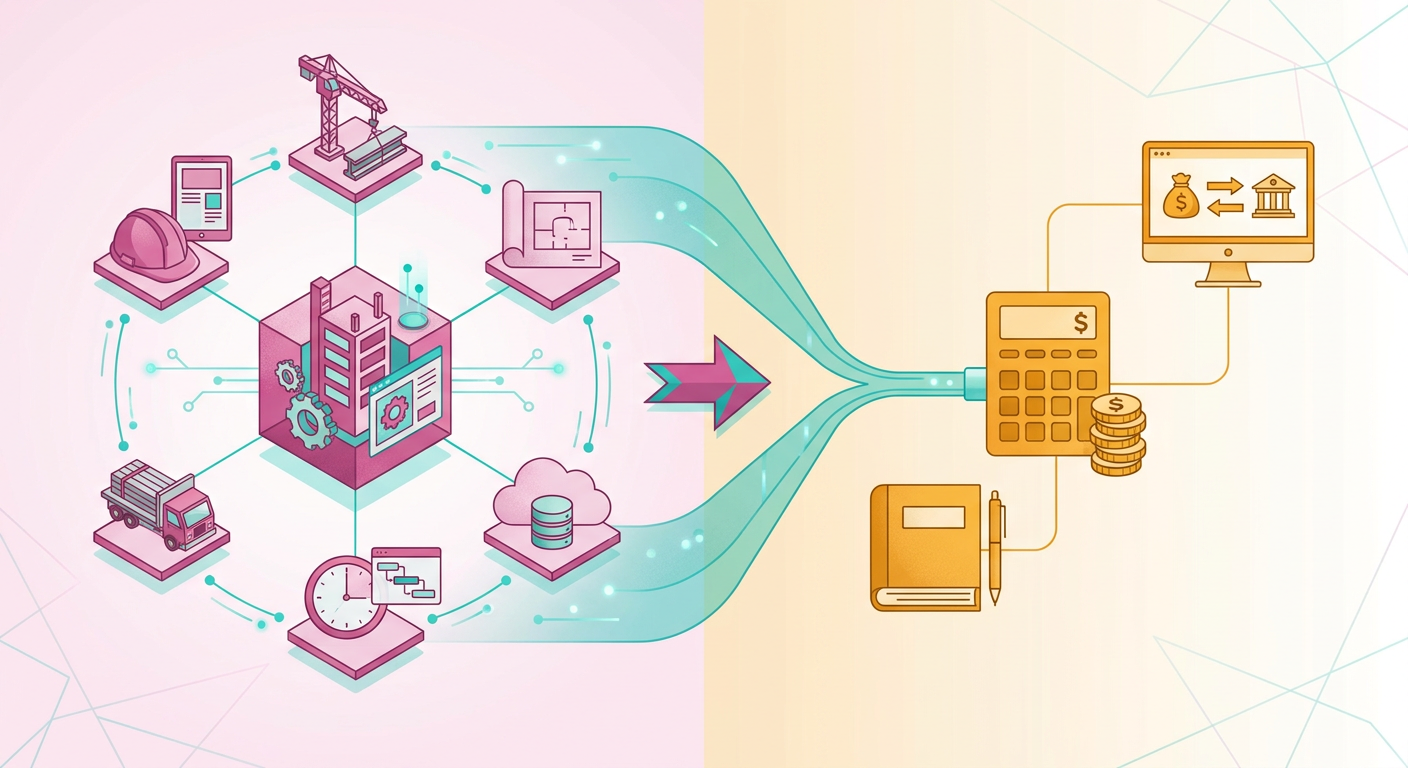
A construction ERP replaces that with one BOQ baseline that drives the tender, the budget, the claims and the cost reports. It does not have to replace your accounting system. In many set-ups the ERP owns the project, BOQ, claims and cost side, and the accounting system stays the book of record, with invoices and payment status synced between them.
Which modules should a Singapore contractor insist on?
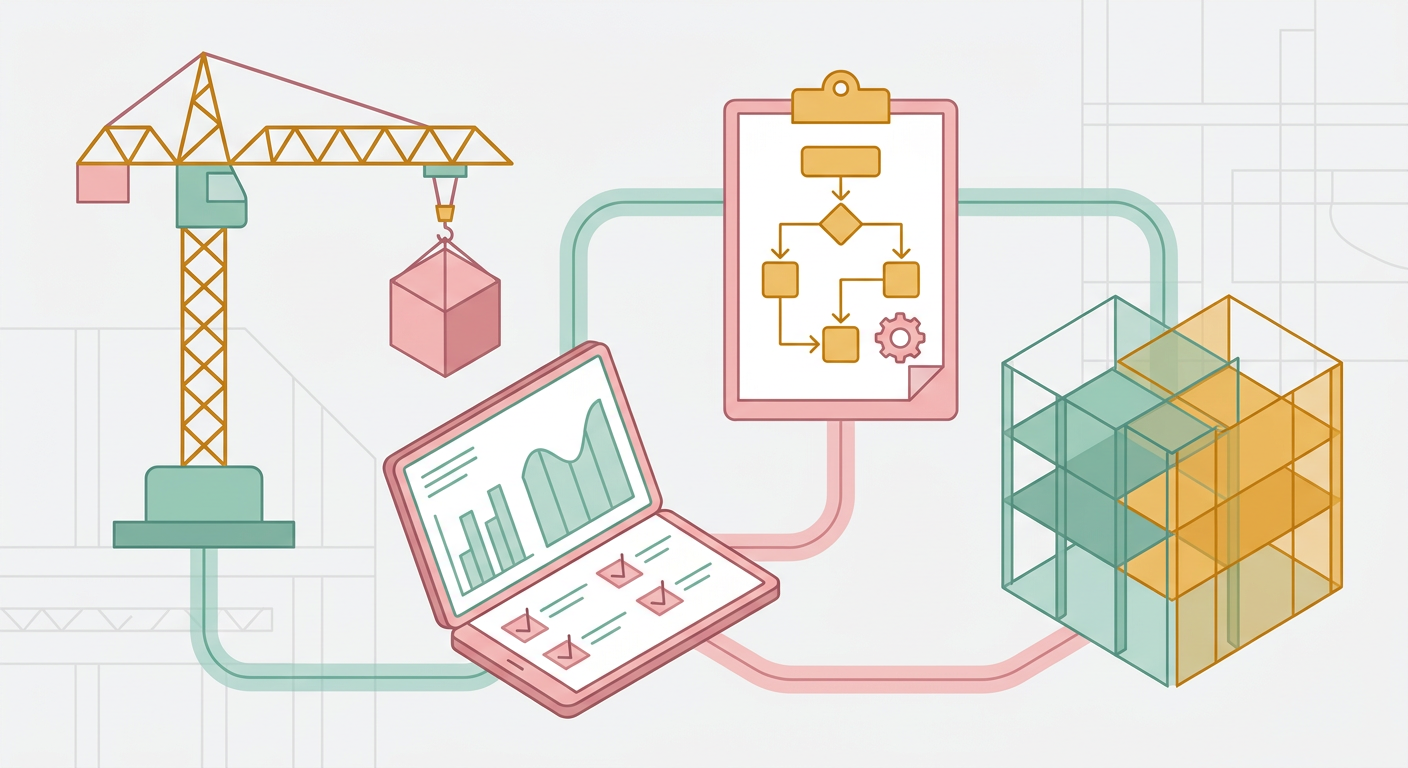
Insist on six: BOQ-based quoting and budgets, progress claims with retention, subcontractor management, variation orders, project costing against budget with committed cost, and a site-friendly mobile view. Procurement, manpower and safety records come next. If a system cannot do the first six, your QS will keep a spreadsheet beside it, and that spreadsheet becomes the real record.
| Module | What to check in the demo |
|---|---|
| BOQ and budgets | A won tender becomes the project budget without retyping a single line. |
| Progress claims | Claims by percentage or quantity done, with previously certified sums carried forward from the system. |
| Retention | Retention applied and capped by your contract terms, with a ledger of what is held and due for release on every project. |
| Subcontractors | Subcontractor claims certified against their work orders, back-charges netted off, and subcontractor retention held. |
| Variation orders | Cost and time impact recorded, client sign-off dated, and the BOQ baseline updated. |
| Project costing | Committed cost visible at purchase order, actual cost and cost-to-complete per cost code. |
| Site mobile view | Deliveries, photos and requisitions captured on a tablet, including where the signal drops. |
For claim cycles in depth, read our guide to progress claims, retention and variations in a construction ERP.
What Singapore rules should a construction ERP support?
Two matter most day to day. The Security of Payment Act sets how payment claims and payment responses are served, so the system should track both sides and their dates. Ministry of Manpower rules limit Work Permit holders by quota and charge a levy, so the system should hold permit and levy data against each worker and project.
On payments, the Building and Construction Authority (BCA) explains that the Act "aims to improve cash flow in Singapore's Built Environment sector by granting parties the statutory right to seek progress payment for work done." BCA also notes that "the claimant is entitled to serve a payment claim within the period stated in the contract or mutually agreed in writing", and that the Act "allows a claimant to apply for adjudication if the claimant disagrees with the response amount or fails to receive payment stated in the payment response." See the BCA Security of Payment Act page.
A contractor is usually both claimant and respondent on the same job, so the ERP should show claims served upstream, claims received from subcontractors, the responses and their dates, per project.
On manpower, the Ministry of Manpower's construction sector page states: "The number of Work Permit holders that you can hire is limited by quota (or dependency ratio ceiling) and subject to a levy." A useful system keeps permit expiry and headcount against each project and raises an alert before a permit lapses, rather than leaving it in an HR folder.
Retention rates, caps and release triggers are contract terms, so the retention module must be configurable per contract.
Should you buy off-the-shelf or build a custom construction ERP?
Buy off-the-shelf if your workflows are conventional and you are willing to change your process to match the software. Build custom if your BOQ structure, claim format or certification chain is specific, if no vendor module models how you work, or if per-seat licences across site supervisors, QS, procurement and finance make the running cost unattractive as you grow.
| Question | Off-the-shelf | Custom build |
|---|---|---|
| Fit to your workflow | Your team adapts to the software | The software is built around your process |
| Time to first use | Fast for standard workflows | Phased, one module at a time |
| Running cost | Per user, per month, rising with headcount | Hosting and optional care, with no per-seat line |
| Ownership | Licensed | The code can be yours, depending on the contract |
A middle route: keep your accounting system and build only the two or three workflows that hurt, usually BOQ and progress claims first. We compare the general trade-off in Odoo vs custom ERP for Singapore SMEs.
How much does construction ERP software cost in Singapore?
There is no single price. Licensed systems usually charge per user per month, and the licence is rarely the whole cost: implementation, data migration, customising modules that do not fit and upgrade effort sit on top. A custom build is quoted on scope. Run both routes over several years, with your own headcount, before deciding.
When you collect quotes, ask each vendor to price the same things:
- Licence or build cost for the modules you need now, and for the ones you will add later.
- Implementation, data migration from your spreadsheets, and integration with your accounting system.
- How many users need access, including site supervisors and part-time staff, and what each extra seat costs.
- Hosting, support, changes after go-live, and your own team's time for interviews, testing and training.
Can an EDGE grant fund construction ERP software?
Possibly. EDG and PSG closed on 29 September 2026, and EDGE is now the route. Its Integrated ERP activity offers up to 50% support for SMEs, up to S$30,000, the activity cost is capped at S$60,000, and the solution must include at least three functions. Whether your project qualifies is for Enterprise Singapore to decide.
The details worth knowing, from Enterprise Singapore's Integrated ERP page and the EDGE FAQ:
- Vendor: You may choose a package from the pre-approved vendors, or engage other vendors if the required functions are not available.
- Annual cap: support for all Automation and Digitalisation projects combined counts towards your company's annual grant cap of S$30,000, within your overall annual grant cap of S$100,000.
- Timing: Businesses must not have started work or made any payment or deposit to a supplier, vendor, or third party prior to application submission. Sign nothing and pay nothing until you have applied.
- Payment: The EDGE grant is administered on a reimbursement basis, so you pay the vendor first and claim afterwards.
- Eligibility: the applicant must be registered in Singapore with at least 30% ownership, direct or indirect, by Singaporean(s) and/or Singapore PR(s).
Source: Enterprise Singapore, Integrated Enterprise Resource Planning
Source: Enterprise Singapore, EDGE Grant FAQ
How should you run a construction ERP evaluation?
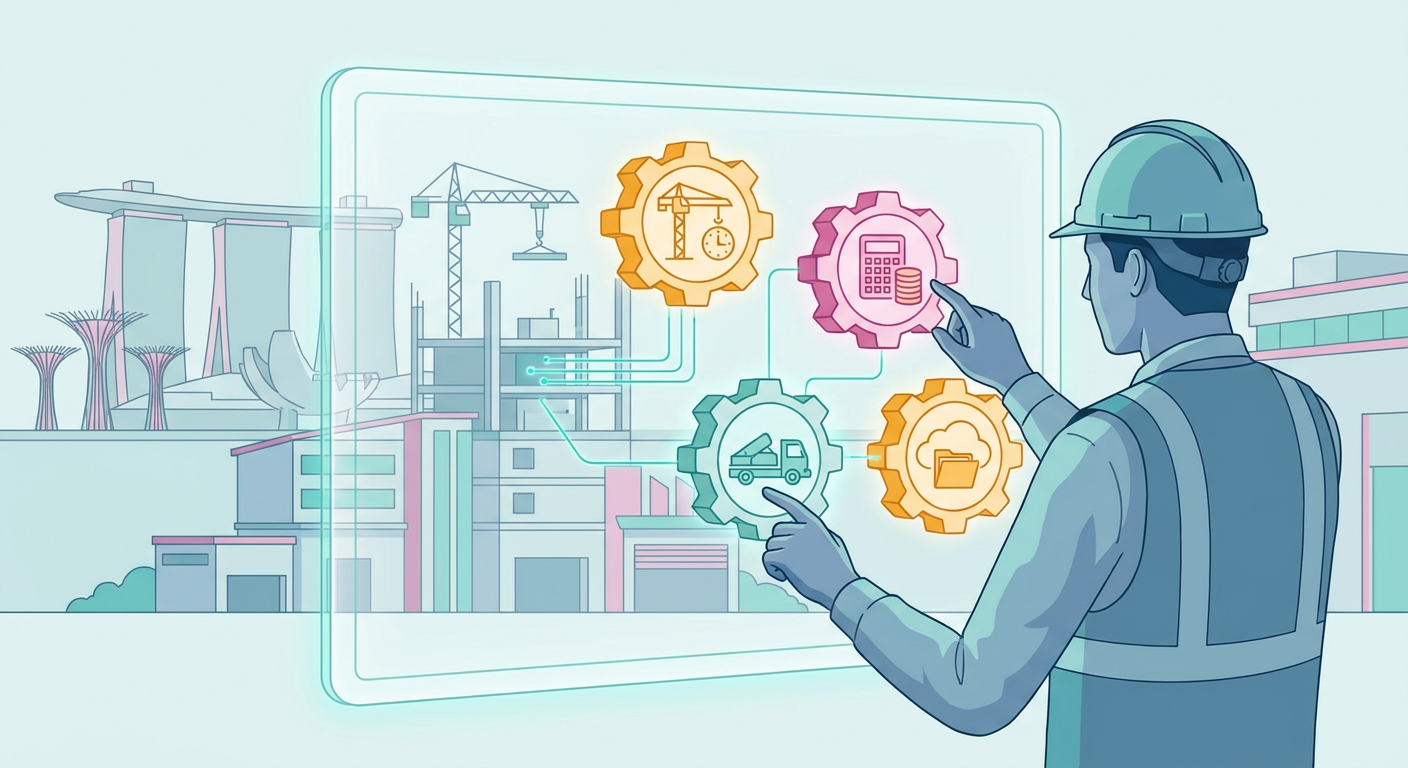
Test every shortlisted system on one of your own live projects. Bring your BOQ, your last certified claim, your retention terms and a few subcontractor certificates, and ask the vendor to run one full claim cycle on screen. Then have a site supervisor try the mobile view. What breaks in that hour tells you more than any feature list.
- Walk one real project end to end with your QS, project manager and finance team, and write down every place data is retyped or waits for someone.
- Rank the handoffs by cost. Late claims, unchased retention and unrecorded variations are the usual leaks.
- Demo on your data. Ask for your BOQ, your claim and your retention rules, not a sample project.
- Phase the rollout. Start with the workflow that costs the most, run it in parallel with the old process for one full cycle, then add the next module once the team is using it daily.

Questions to ask any construction ERP vendor
- Can a won tender become the project budget without retyping?
- How are previously certified sums carried forward between claim cycles?
- Can retention rates, caps and release dates be set per contract, and where do I see what is due for release?
- Can I see subcontractor claims, back-charges and retention beside my own claims on one project?
- Where does committed cost appear: at purchase order, or only at invoice?
- What does the site view look like on a tablet, and what happens when there is no signal?
Construction ERP software from Digital 9 Labs
Digital 9 Labs builds construction ERP software for Singapore contractors, main contractors and subcontractors: BOQ-based quoting, progress claims with retention, subcontractor management, variation orders, and project costing checked against budget while the job is still live. Invoices and payment status can sync to Xero or your existing accounting tool.
We do not rebuild an entire ERP suite. We start with one claim cycle: you walk us through your BOQ, valuation, previous certificates and retention terms, and we scope the first workflow around the rules your team actually uses. The first module is usually BOQ plus progress claims, or procurement plus subcontractors, and its rollout is usually spread across six to eight weeks. Focused modules start from S$3,500, a starting point for a scoped module rather than a price for an entire construction ERP, with migration, integrations and extra modules quoted explicitly. On a custom ERP build the code is yours, and if an off-the-shelf product fits your process, we will say so.
Frequently asked questions
Is construction ERP software the same as project management software?
No. Project management software tracks tasks and schedules. Construction ERP software also runs the money: BOQ budgets, progress claims, retention, subcontractor certificates, purchase orders and cost against budget per project, with the figures shared by QS, procurement, finance and management.
Does a construction ERP replace our accounting system?
It does not have to. A common set-up lets the ERP own the project, BOQ, claims and cost side while your accounting system stays the book of record, with invoices, purchase invoices and payment status synced between the two.
How long does a construction ERP take to implement?
It depends on scope. Phasing works better than one big go-live: start with the costliest workflow, run it in parallel for one claim cycle, then add modules. At Digital 9 Labs, the rollout of a focused first module is usually spread across six to eight weeks.
Can the EDGE grant pay for a construction ERP?
Possibly. EDGE's Integrated ERP activity offers up to 50% support for SMEs, up to S$30,000, on a reimbursement basis. Work must not start, and no deposit may be paid, before you apply. Enterprise Singapore decides whether a project qualifies.
About the author: Samuel Chan is the Founder of Digital 9 Labs, which builds custom ERP and business software for Singapore SMEs.