Odoo vs Custom ERP for Singapore SMEs: Where Each One Actually Fits
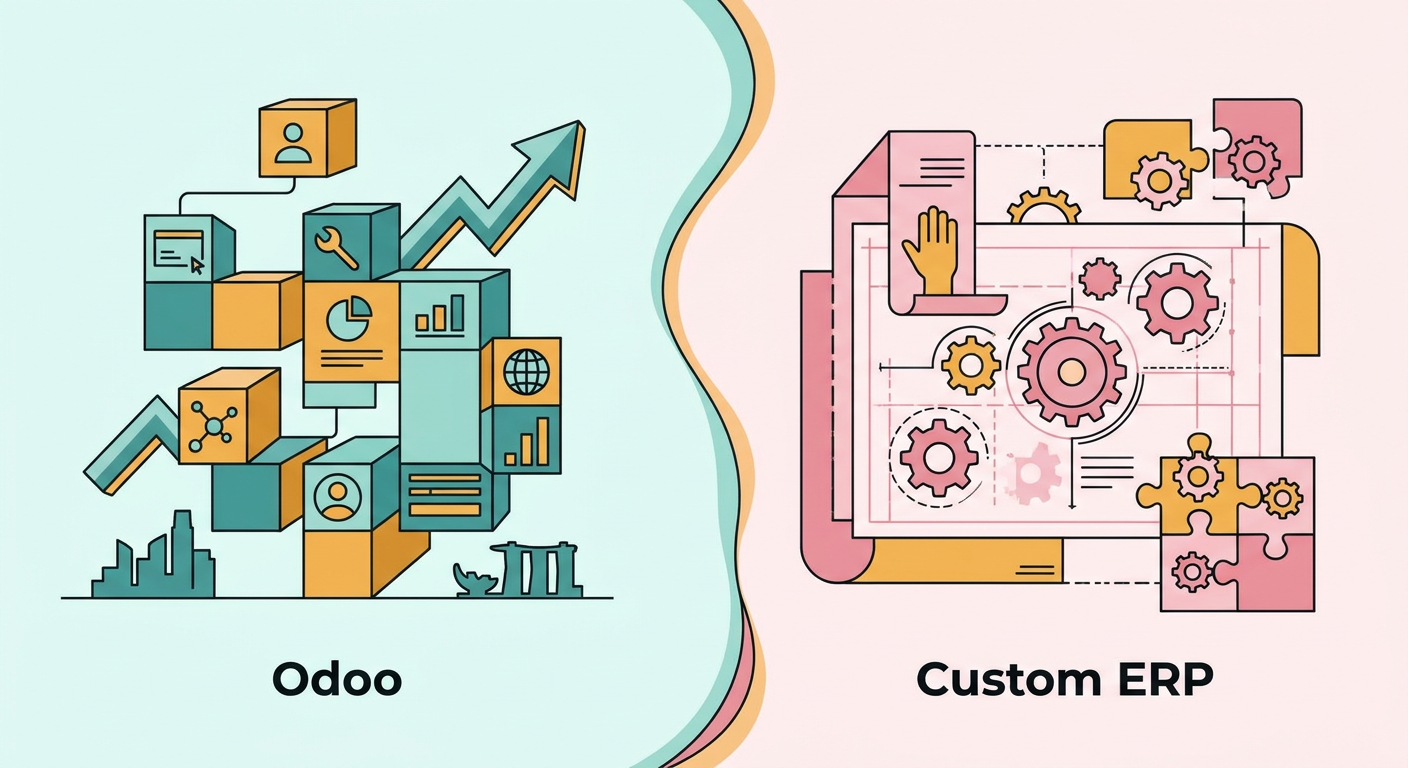
Odoo vs custom ERP is the choice between Odoo, an open-source modular ERP that you switch on module by module, and a custom ERP, which is software built specifically for your business. For most Singapore SMEs, the deciding factor is fit: how fast you can go live, how much control you need over workflows and what you will pay over time.
Key takeaways
- Odoo trades exact fit for speed and lower cost, while a custom ERP trades speed and cost for exact fit.
- Odoo suits trading and distribution businesses, SMEs that need to go live fast and companies with standard processes.
- Custom ERP suits highly specialised or regulated operations, and businesses whose own process is the product.
- On total cost of ownership, Odoo usually comes out ahead for SMEs with standard processes.
- A hybrid of Odoo plus one or two custom modules gives platform economics with targeted fit.
For Singapore SMEs weighing Odoo vs a custom ERP, the decision rarely comes down to features alone. It comes down to fit — how fast you can go live, how much control you need over workflows, what your total cost of ownership looks like over five years, and whether your operations are standard enough for an off-the-shelf platform or specialised enough to justify building software from scratch. Odoo, an open-source modular ERP with a strong presence in Singapore's SME market, handles the majority of back-office needs out of the box. Custom ERP development gives you exactly what you specify — and nothing you don't pay for. This guide breaks down where each one actually fits, with Singapore-specific context on costs, compliance, talent, and growth scenarios.
The Real Difference Between Odoo and Custom ERP
What "custom ERP" actually means in practice
In practice, a custom ERP is software specified by you and built by a development team, either from a blank codebase or from a heavily modified framework, so that every module, workflow and report matches how your business runs.
A custom ERP is software built specifically for your business — either from a blank codebase or heavily modified from a framework. Every module, workflow, and report is specified by you and built by a development team, usually over six to eighteen months. In Singapore, this typically means engaging a local software house or an offshore development team, with costs ranging from S$80,000 for a lean build to well over S$500,000 for a full enterprise-grade system.
How Odoo's modular approach works
Odoo works as a suite of integrated business apps that you switch on as you need them. You start with core modules such as Accounting and Inventory, add others later, and meet most requirements through configuration and light customisation rather than full development.
Odoo is a suite of integrated business applications — accounting, inventory, CRM, manufacturing, HR, eCommerce, and more — that you switch on as needed. You start with what you need (say, Accounting and Inventory) and add modules later. Because it's open-source with thousands of apps and an active partner ecosystem in Singapore, most SME requirements are met through configuration and light customisation rather than full development. Odoo is also an IRAS ASRAS-listed accounting software vendor, which matters for GST compliance in Singapore.
The core trade-off in one sentence
Odoo trades perfect fit for speed and lower cost; custom ERP trades speed and cost for perfect fit. Everything else in this article is a variation on that theme.
| Dimension | Odoo | Custom ERP |
|---|---|---|
| Time to go live | 1–4 months | 6–18 months |
| Typical upfront cost (SME) | S$5k–S$50k implementation | S$80k–S$500k+ build |
| Fit to unique workflows | Good with customisation | Exact by design |
| Ongoing upgrades | Handled by Odoo/partner | You fund and manage |
| GST/IRAS compliance | Built-in, ASRAS-listed | Must be built and maintained |
| Vendor lock-in risk | Low (open source) | High (your codebase) |
Where Odoo Actually Fits for Singapore SMEs
Trading, distribution, and e-commerce businesses
If you buy, stock, sell, and ship physical goods, Odoo is arguably the strongest value-for-money option in its class. Inventory, purchase, sales, and accounting modules are natively integrated, and the Singapore localisation handles GST reporting, PEPPOL e-invoicing (via the InvoiceNow network), and multi-currency transactions. For SMEs selling on Shopee, Lazada, and Shopify simultaneously, Odoo's connectors consolidate orders into one inventory truth.
SMEs that need to go live fast
A typical Singapore Odoo implementation — accounting, sales, inventory, basic HR — runs eight to sixteen weeks with a local partner. That speed matters when you're replacing a failing system, chasing an audit deadline, or scaling past what spreadsheets can handle. Custom builds simply cannot match this timeline.
Businesses with standard-ish processes
Odoo fits best where your workflows are recognisably standard: quote-to-cash, procure-to-pay, basic manufacturing, project billing. If your competitive edge comes from execution rather than exotic internal processes, Odoo gives you 90% of the functionality for 10% of a custom build's cost.
Cost-sensitive scaling
Odoo Community edition is free; paid plans are listed on Odoo's pricing page at US$13.50 to US$16.90 per user per month for Standard and US$25 to US$32 for Custom (November 2026). Even with implementation and support, total cost of ownership over five years is usually a fraction of a custom build — and Singapore SMEs can offset qualifying digitalisation costs through the EDGE Grant, which replaced the Enterprise Development Grant (EDG) for new applications from 30 September 2026.
Before you budget, check the current plans and per-user prices on Odoo's own pricing page.
Where Custom ERP Actually Fits for Singapore SMEs
Highly specialised or regulated operations
If you run a precision engineering firm with shop-floor control requirements, a specialised logistics operation with unique routing logic, or a financial services business with MAS reporting obligations, off-the-shelf software forces painful workarounds. Custom ERP makes the software conform to the operation, not the reverse.
Businesses whose process IS the product
Some SMEs compete on proprietary workflows — a unique production scheduling algorithm, an unusual billing model, deeply integrated customer portals. Building these into Odoo can cost more than building a focused custom system, because you're fighting the framework's assumptions. When your differentiator lives in software, owning the codebase has strategic value.
Long-term cost control at scale
Per-user licensing fees compound. A 200-user company paying S$40/user/month spends nearly S$100k per year on subscriptions alone. Beyond a certain size, a custom system with no recurring licence fees can break even within five to seven years — provided you budget realistically for maintenance, which most companies underestimate.
Integration-heavy environments
If your ERP must sit at the centre of a complex web — legacy machinery, bespoke warehouse automation, industry-specific third-party systems — a custom ERP can be architected as a purpose-built hub. Odoo integrates well with common tools, but unusual integrations remain development projects either way.
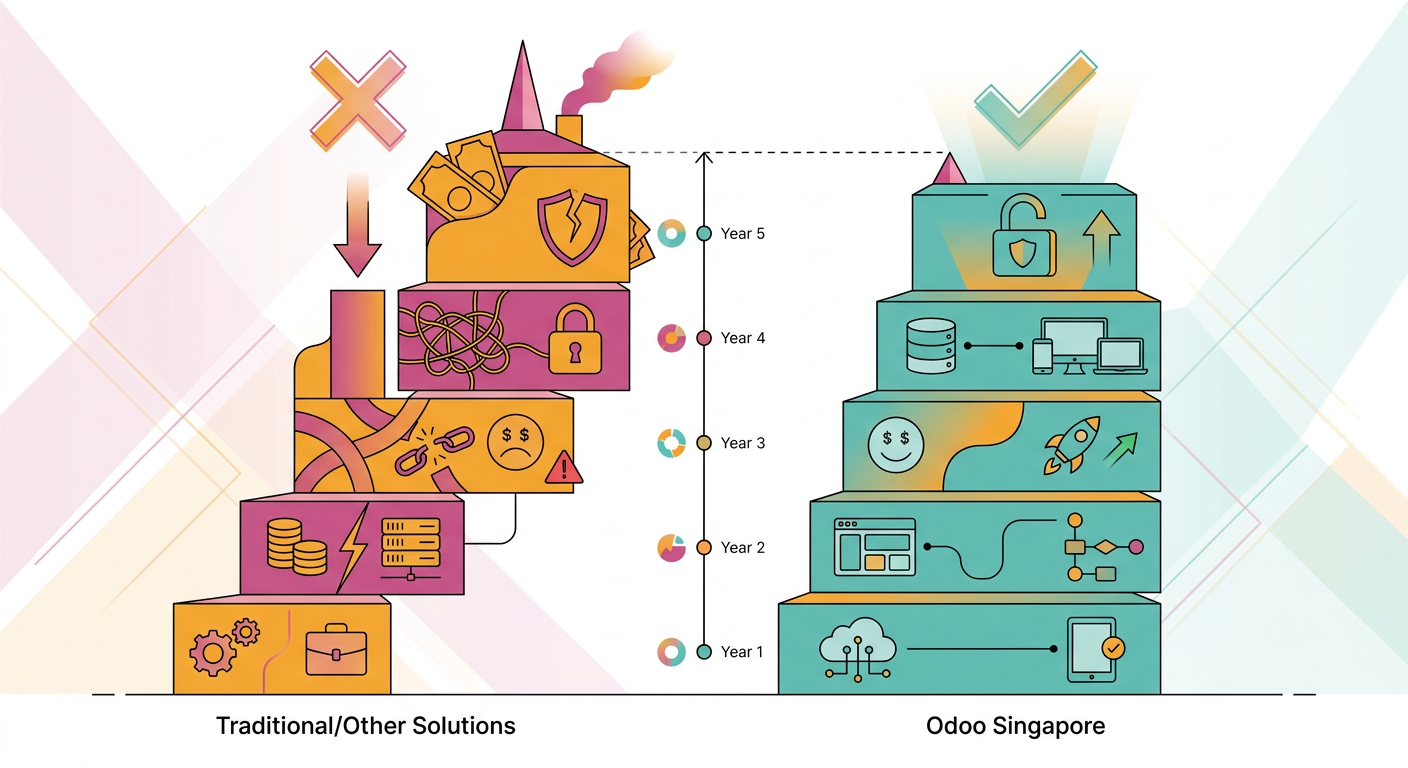
Cost Comparison: TCO Over Five Years
Upfront and implementation costs
A realistic Singapore Odoo implementation for a 20–50 person SME lands between S$15,000 and S$60,000 depending on modules and customisation. A custom ERP for the same business starts around S$80,000 and realistically S$150,000–S$300,000 once you include specification, development, testing, data migration, and training.
Recurring costs
Odoo's recurring costs include subscription fees (Enterprise), hosting, and partner support — typically S$500–S$3,000 monthly for a small SME. Custom ERP eliminates licences but introduces maintenance retainers, server costs, and developer dependency: budget 15–20% of build cost annually, forever.
Hidden costs that surprise everyone
- Odoo: scope creep in customised modules making upgrades painful; heavy custom apps that need rewriting every major version.
- Custom: documentation debt, key-developer dependency, and the cost of adding features Odoo would give you free (e.g., a full accounting module rewritten from scratch).
A five-year illustrative comparison (30 users)
| Cost Item | Odoo Enterprise (5 yrs) | Custom ERP (5 yrs) |
|---|---|---|
| Licence / build | S$54,000 (subscriptions) | S$180,000 (one-off) |
| Implementation / specification | S$30,000 | S$40,000 |
| Annual maintenance / support | S$60,000 | S$135,000 |
| Upgrades & enhancements | S$15,000 | S$60,000 |
| Total (approx.) | S$159,000 | S$415,000 |
Figures are illustrative; actuals vary with scope. The pattern, however, is consistent: Odoo wins on TCO for most SMEs under ~100 users with standard processes.
Compliance and Localisation: GST, IRAS, and Singapore Requirements
IRAS ASRAS listing and GST compliance
Since 2023, GST-registered businesses in Singapore must use IRAS-listed accounting software (or retain records per IRAS requirements). Odoo is ASRAS-listed and maintained by its localisation community and partners, meaning GST F5 returns, GST rate handling, and audit trails are supported. A custom ERP must be built to meet IRAS' information requirements and formally reviewed — an ongoing obligation whenever tax rules change.
InvoiceNow and PEPPOL e-invoicing
Singapore's nationwide shift to InvoiceNow (PEPPOL-based e-invoicing) is increasingly expected in B2B and government transactions. Odoo supports PEPPOL natively in recent versions; a custom build requires integrating with a PEPPOL access point yourself.
IRAS explains how InvoiceNow applies to GST-registered businesses on its GST InvoiceNow Requirement page, and our guide to InvoiceNow and the GST e-invoicing mandate covers what SMEs need to do.
CPF, IR8A, and payroll localisation
Odoo's Singapore localisation covers CPF contributions, IR8A auto-submission, SDL, and FWL. Custom payroll modules must be updated every time CPF rates or IRAS submission formats change — a small but relentless maintenance burden that catches many custom-build owners off guard.
Audit, data residency, and PDPA
Both approaches can satisfy PDPA, but consider where data is hosted. Odoo can be self-hosted or run on Singapore-region cloud; custom ERPs give full control over data residency. For government-linked or sensitive-sector contracts, this flexibility may influence the decision.
Implementation Timelines and Risk
Realistic Odoo timelines
Phase-wise: scoping (1–2 weeks), configuration and migration (3–6 weeks), testing and training (2–4 weeks). Most Singapore SMEs go live within one to four months. The main risk is poor data migration and under-scoping — mitigated by choosing an experienced local Odoo partner.
Realistic custom ERP timelines
Requirements and design (2–3 months), development (4–9 months), UAT and rollout (2–3 months). The dominant risk is requirements drift: what you specified eighteen months ago may not match how your business works at go-live. Studies consistently show a majority of large custom software projects run over budget or late.
Which failure mode hurts more?
Odoo's failure mode is "works but doesn't quite fit" — usually fixable with more configuration. Custom ERP's failure mode is "never finished or abandoned" — a sunk cost with no fallback. SMEs with limited cash buffers should weight this asymmetry heavily.
The hybrid middle path
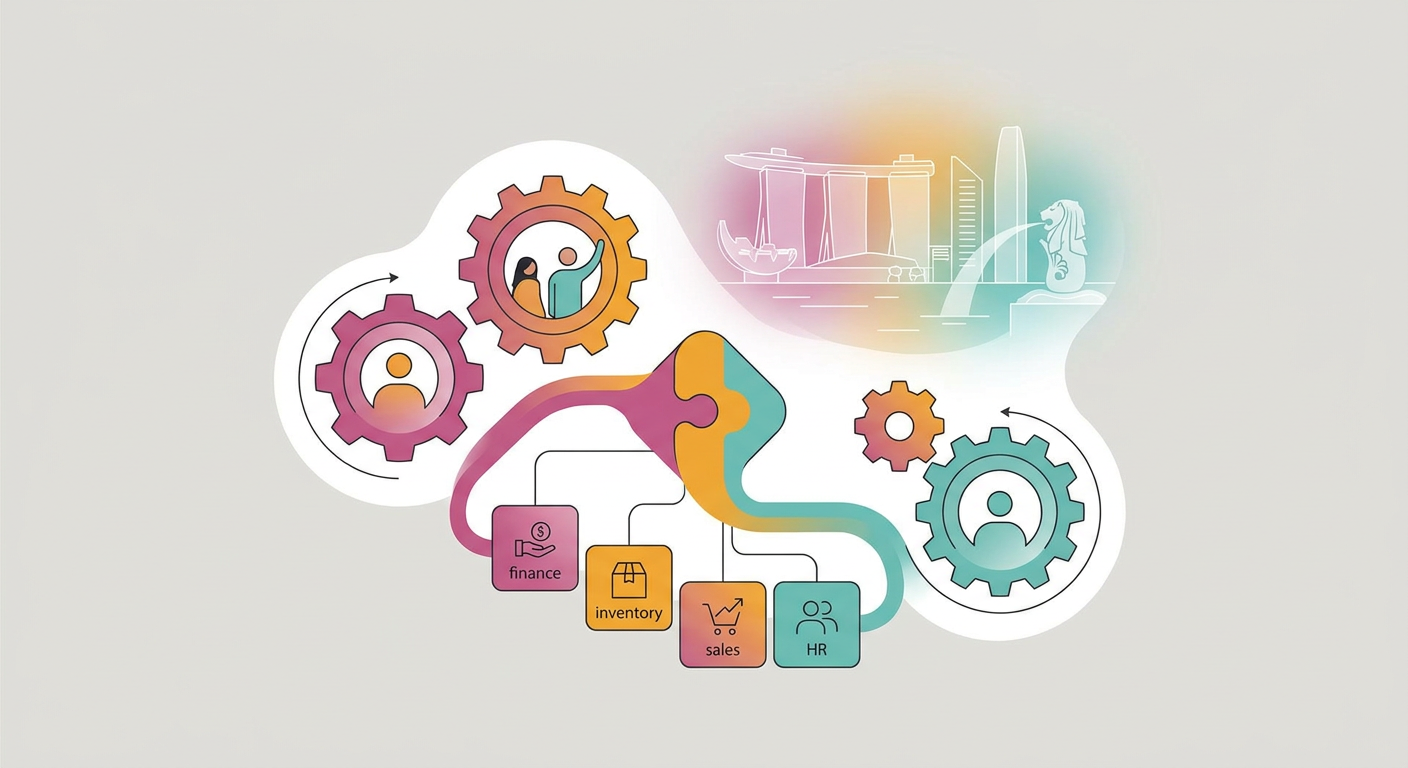
Many Singapore SMEs land on a pragmatic hybrid: Odoo as the backbone, with one or two custom-built Odoo modules for genuinely unique workflows. You get platform economics plus surgical fit, without owning the entire stack.
If you are still comparing platforms, our guide to Odoo alternatives in Singapore sets out other options to weigh.
How to Decide: A Practical Framework
Decide by asking how standard your processes are, how soon you need to be live, what your all-in budget is and whether your own process is the reason customers choose you. The questions and company profiles below map each answer to Odoo, custom or a hybrid.
Five questions that settle it
- Are your core processes standard for your industry? → Odoo.
- Do you need to be live within three months? → Odoo.
- Is your budget under S$100k all-in? → Odoo.
- Is your proprietary process the reason customers choose you? → Custom or hybrid.
- Will you exceed ~150–200 users with heavy transaction volumes? → Model both TCOs carefully.
Decision by company profile
| Business Profile | Recommended Path |
|---|---|
| Trading / distribution SME | Odoo (standard) |
| F&B multi-outlet | Odoo + POS integrations |
| Light manufacturing | Odoo with MRP customisations |
| Precision engineering with shop-floor control | Custom or hybrid |
| Fintech / regulated operations | Custom |
| Professional services | Odoo (standard) |
When to switch from one to the other
Switch when the warning signs are clear: custom modules dominate your Odoo set-up and every upgrade becomes a rebuild, or a custom plan is still defining requirements long after it started. Both situations are recoverable.
Signs you've outgrown Odoo: custom modules now dominate your implementation, every upgrade is a rebuild, and your team fights the software daily. Signs a custom plan was premature: you're six months in and still defining requirements, or the budget has doubled. Both situations are recoverable — Odoo's open data model makes importing from a failed custom system feasible, and custom builds can reuse Odoo's open-source components.
Frequently Asked Questions
Is Odoo good enough for Singapore SMEs, or is it just for small businesses?
Odoo scales comfortably from five-person startups to multi-entity companies with hundreds of users. Its modular design means SMEs start small and grow into it. Many Singapore companies run their entire operation — accounting, inventory, manufacturing, HR — on Odoo for years without hitting platform limits.
How much does Odoo cost in Singapore compared to a custom ERP?
A typical Odoo implementation for a small SME costs S$15,000–S$60,000 upfront plus S$500–S$3,000 monthly in subscriptions and support. A custom ERP typically starts at S$80,000 and realistically lands between S$150,000–S$300,000, plus 15–20% of build cost in annual maintenance. Over five years, Odoo is usually 40–60% cheaper for companies under ~100 users.
Can Odoo handle IRAS GST and Singapore payroll requirements?
Yes. Odoo is on IRAS' ASRAS list of compliant accounting software and its Singapore localisation covers GST returns, CPF calculations, IR8A auto-submission, and PEPPOL/InvoiceNow e-invoicing. Confirm with your implementation partner that they enable and maintain the localisation modules.
When is a custom ERP genuinely worth it?
When your workflows are so specialised that configuring Odoo costs more than building from scratch, when regulatory requirements demand bespoke reporting, when your proprietary process is your competitive advantage, or when per-user licensing at large scale makes subscriptions uneconomical.
Can I start with Odoo and move to custom later?
Yes, and it's often the smartest sequence. Odoo's open data model and structured database make migration straightforward, and you'll arrive at a custom build with far clearer requirements after running a real system. Many companies also simply extend Odoo with custom modules rather than ever leaving the platform.
Are there grants for ERP implementation in Singapore?
Yes. From 30 September 2026 the EDGE Grant replaced the Enterprise Development Grant (EDG). Its Integrated Enterprise Resource Planning activity offers up to 50% support for SMEs (up to S$30,000). Check current eligibility and caps with Enterprise Singapore or your vendor, as grant terms change periodically.
Conclusion: Fit Beats Feature Lists
The Odoo vs custom ERP question has a clear default answer for most Singapore SMEs: start with Odoo. It's faster, cheaper, locally compliant, and flexible enough to cover the vast majority of trading, services, and light-manufacturing operations. Choose custom when your process is genuinely your product, when regulation demands it, or when scale makes licensing economics swing — and even then, consider the hybrid route of Odoo plus targeted custom modules before committing to a full build. Whichever path you take, invest in requirements clarity, a capable implementation partner or development team, and realistic budgeting for the years after go-live. The best ERP is not the one with the longest feature list; it's the one that fits how your business actually runs.