OpenAI GPT-5.6 vs Claude Fable 5: Which Frontier AI Model Fits Your Singapore Business?
GPT-5.6 vs. Claude Fable 5
A practical guide for Singapore SMEs: It's not about which model is better, but which is best for the job.
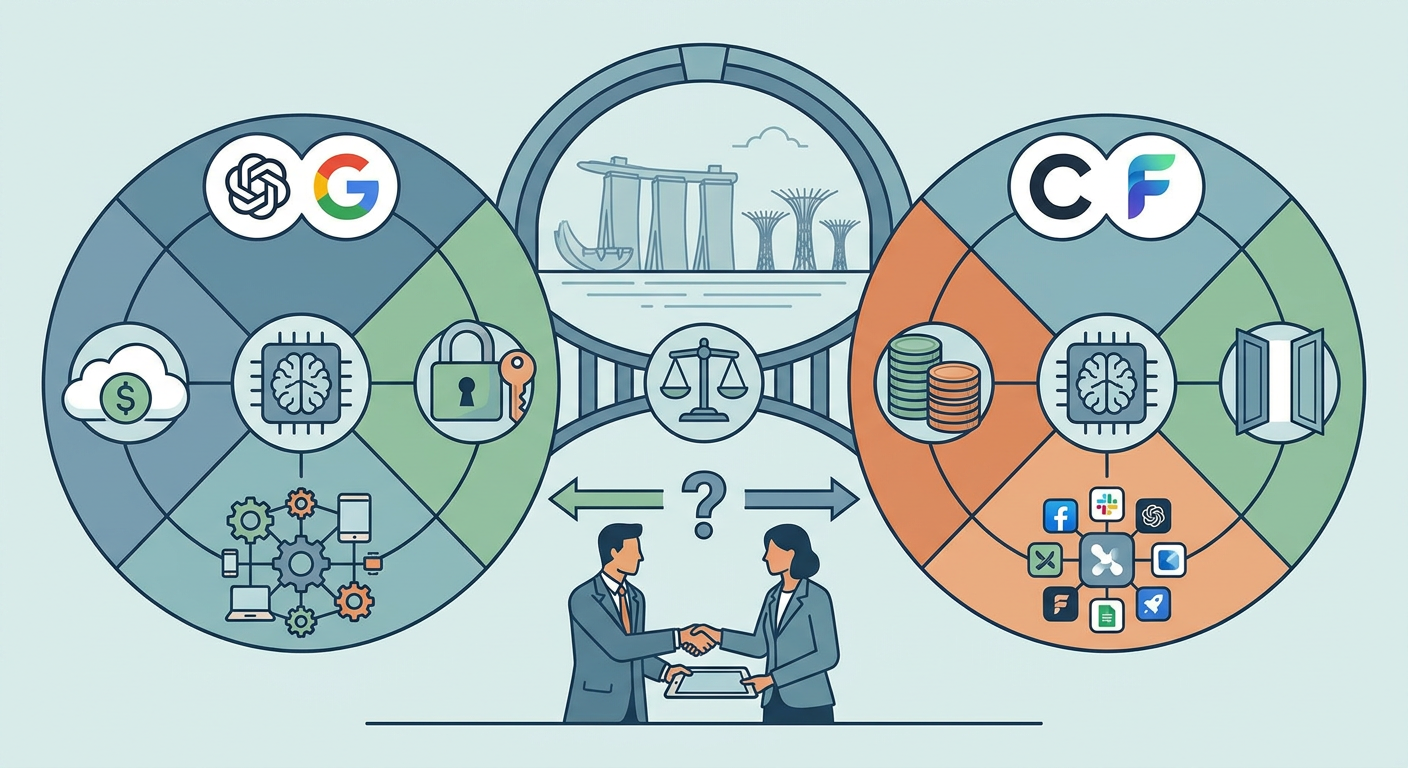
OpenAI GPT-5.6
The Scale & Speed EngineKey Strengths
- Ultra-Long Context
Analyzes ~1M+ tokens at once - Cost-Effective Tiers
Optimize cost with Sol, Terra, Luna - Terminal Agent Prowess
Leads on TerminalBench 2.1
Claude Fable 5
The Reasoning & Reliability ExpertKey Strengths
- Complex Reasoning
Excels at multi-step logic - High-Stakes Coding
Strong on SWE-Bench Pro - Agentic Reliability
Dependable for critical workflows
The Winning Strategy: Use Both
Advanced teams don't choose one model; they build a smart system that routes each task to the best tool for the job, optimizing for performance, cost, and reliability.
The AI landscape is fiercely competitive, and for Singapore SMEs, the choice between frontier models can define your operational efficiency and innovation trajectory. The arrival of OpenAI’s latest models has sparked a critical debate: OpenAI 5.6 vs Claude Fable 5. This decision isn't just about picking the "best" AI; it's about selecting the right tool for specific jobs, from powering agentic ERPs and complex automations to building reliable internal tools. This practical, data-driven guide is designed for tech leaders and business owners in Singapore to cut through the hype, compare these two titans on performance and cost, and understand how to leverage both for maximum business impact.
A practical, data-driven guide for Singapore SMEs comparing OpenAI GPT‑5.6 and Claude Fable 5. Learn how each performs on coding, long-context work, ERPs, and automations—and how Digital 9 Labs helps you pick the right model per workflow.
Quick Verdict: GPT‑5.6 vs Fable 5 for Singapore SMEs
For busy founders and decision-makers in Singapore, the choice between GPT-5.6 and Claude Fable 5 isn't about crowning a single winner. The smartest strategy involves understanding their distinct strengths and using them where they shine brightest. The contest of OpenAI 5.6 vs Claude Fable 5 is less of a zero-sum game and more about building a sophisticated, hybrid AI toolkit.
When GPT‑5.6 is the Better Choice
OpenAI’s GPT-5.6 family, particularly its top-tier GPT-5.6 Sol variant, is the preferred model for tasks demanding elite performance in specific domains and massive scale. Public benchmark data shows GPT‑5.6 Sol setting a new state of the art on TerminalBench 2.1, with Sol and Sol Ultra occupying the top two positions among widely used coding models.
Source: LushBinary – GPT‑5.6 Sol vs Fable 5 vs Opus 4.8
Furthermore, GPT‑5.6’s very large context window (reported around the million‑token range in early technical write‑ups) is designed for processing and reasoning over extremely large documents, such as entire codebases or comprehensive regulatory handbooks.Source: ExplainX – GPT‑5.6 vs Fable 5 comparison
For cost-sensitive AI workloads that need to operate at high volume, the tiered structure of GPT-5.6 models (Sol, Terra, Luna) allows for more granular cost control, a significant advantage for SMEs managing tight budgets.Source: LushBinary – GPT‑5.6 Sol vs Fable 5 vs Opus 4.8
The deep integration with the broader OpenAI ecosystem advantages, including its mature API and tooling, provides a stable and familiar development experience.When Claude Fable 5 is the Better Choice
Anthropic's Claude Fable 5 excels where complex, multi-step reasoning and coding are paramount. Before the release of GPT-5.6, Fable 5 established a clear lead over GPT-5.5 on difficult coding benchmarks like SWE-Bench Pro and FrontierCode Diamond, with Fable 5 scoring around 72% on SWE‑Bench Pro compared with roughly 68% for GPT‑5.5, and posting a FrontierCode Diamond score over five times higher than GPT‑5.5’s.
Source: MindStudio – Claude Fable 5 vs GPT‑5.5
Source: ExplainX – GPT‑5.6 vs Fable 5 comparison
This translates to superior reliability for complex software engineering tasks, such as refactoring legacy code, debugging intricate issues, or executing multi-step development plans. Its strength in multi-step reasoning AI makes it the more dependable choice for building high-stakes, agentic coding workflows where accuracy and logical coherence are non-negotiable.Source: MindStudio – Claude Fable 5 vs GPT‑5.5
If your primary goal is to create an autonomous agent that can understand a complex business problem and write robust, production-ready code to solve it, Fable 5 is often the more reliable and performant option.Why Most Singapore Teams Should Use Both Models
The most advanced and pragmatic approach is not to choose one vendor but to embrace a model routing architecture. Serious AI engineering teams are moving beyond vendor loyalty and instead focus on workflow optimisation, combining models that lead different benchmarks in a single system.
Source: ExplainX – GPT‑5.6 vs Fable 5 comparison
This means you should use GPT and Claude together. For example, you can route a request to summarise a million‑token legal discovery bundle to GPT-5.6, while a task to fix a critical bug in your ERP's Python backend gets routed to Claude Fable 5. This hybrid strategy, a core tenet of Singapore AI engineering best practices, ensures you're always using the best—and most cost-effective—tool for the job, improving resilience and avoiding vendor lock-in.
Benchmark Deep Dive: How GPT‑5.6 and Fable 5 Really Compare
Raw performance metrics are the foundation for any serious model evaluation. The latest frontier benchmarks provide a data-driven lens for the GPT-5.6 vs Fable 5 benchmarks comparison, revealing nuances that directly impact real-world applications like coding, agentic workflows, and knowledge work. Let's break down the scores and what they mean for your business.
TerminalBench 2.1: Autonomous Coding in the Terminal
TerminalBench 2.1 is a critical benchmark that measures an AI's ability to perform software engineering tasks autonomously within a live terminal environment—a direct proxy for building powerful coding agents. Here, GPT-5.6 Sol takes the lead, setting a new state-of-the-art on this benchmark across commonly deployed coding models.
Source: LushBinary – GPT‑5.6 Sol vs Fable 5 vs Opus 4.8
However, the competition is incredibly close among the next tier. The official TerminalBench 2.1 chart and technical write‑ups show that Claude Fable 5 ties with GPT-5.6 Terra at 84.3%, indicating both models possess formidable capabilities for building autonomous terminal agents.Source: Terminal‑Bench 2.1 model scores
Source: LushBinary – GPT‑5.6 Sol vs Fable 5 vs Opus 4.8
For SMEs looking to automate server administration, CI/CD pipeline management, or complex script execution, this means both models are highly capable, with GPT-5.6 Sol offering a clear edge for the most demanding terminal-based tasks.SWE‑Bench Pro and FrontierCode: Hard Coding Tasks
While TerminalBench focuses on agentic execution, benchmarks like SWE-Bench Pro and FrontierCode Diamond measure a model's ability to solve challenging, real-world software engineering problems. In earlier comparisons, SWE-Bench Pro Fable 5 vs GPT consistently showed Fable 5 outperforming GPT-5.5, with Fable 5 scoring roughly 72% on SWE‑Bench Pro vs about 68% for GPT‑5.5.
Source: MindStudio – Claude Fable 5 vs GPT‑5.5
On FrontierCode Diamond, Fable 5 also leads strongly, with published results placing it at 29.3 versus 5.7 for GPT‑5.5.Source: ExplainX – GPT‑5.6 vs Fable 5 comparison
These gaps suggested a deeper "understanding" of code and an ability to handle complex logic. While GPT-5.6 has narrowed some of this gap, particularly on agentic and long-context coding tasks, current public data still shows Fable 5 maintaining an edge on the hardest multi-file repair and refactoring workloads. The hard coding benchmark implications are clear: for critical, complex coding tasks where correctness is paramount, Fable 5 remains a top contender, while GPT-5.6 is catching up rapidly.General Reasoning, Research and Long-Context Work
Beyond coding, reasoning over vast amounts of information is a key battleground. Here, context window size is a major differentiator. Claude Fable 5 operates comfortably with a 200K token context, according to Anthropic-focused benchmark analyses.
Source: MindStudio – Claude Fable 5 vs GPT‑5.5
GPT‑5.6, by contrast, is documented as targeting context windows in the 1M+ token range, with some reports indicating around 1.5M tokens in its top configuration.Source: ExplainX – GPT‑5.6 vs Fable 5 comparison
This 200K vs ~1M+ token context difference has massive implications. GPT-5.6 can ingest and analyze entire code repositories, massive technical manuals, or years of financial reports in a single prompt. This makes it a titan of long-context reasoning AI. For tasks like research synthesis AI where you need to distill insights from hundreds of documents, or for large-scale document summarisation GPT vs Claude, the sheer scale of GPT-5.6's context window gives it a decisive structural advantage.| Feature | OpenAI GPT-5.6 (Sol/Terra) | Anthropic Claude Fable 5 |
|---|---|---|
| Best For | Autonomous terminal agents, ultra-long context analysis, cost-sensitive high-volume tasks. | Complex multi-step coding, high-stakes reasoning, agentic software development. |
| Key Benchmark Lead | TerminalBench 2.1 (Sol variant leads the benchmark among widely deployed coding models). | Documented leads on SWE-Bench Pro & FrontierCode Diamond against GPT-5.5. |
| Context Window | Reported in the ~1M+ token range, enabling whole-codebase and corpus analysis. | ~200,000 tokens, excellent for most large documents and projects. |
| Pricing Model | Tiered (Sol, Terra, Luna) allowing for cost/performance trade-offs. | Premium pricing reflecting its top-end capabilities. |
| Ecosystem & Tooling | Mature API, deep integrations, vast developer tooling from OpenAI. | Excellent tool-use reliability with "Skills"; strong focus on safety and predictability. |
Source: MindStudio – Claude Fable 5 vs GPT‑5.5
Source: LushBinary – GPT‑5.6 Sol vs Fable 5 vs Opus 4.8
Source: ExplainX – GPT‑5.6 vs Fable 5 comparison
Cost, Access and Ecosystems: Beyond Raw Performance
While benchmark scores are important, real-world deployment decisions for Singapore SMEs hinge on practical factors: pricing, availability, and the surrounding ecosystem. The GPT-5.6 Sol pricing and Claude Fable 5 API cost structures are fundamentally different, influencing which model is viable for certain use cases. Furthermore, navigating limited preview vs general availability and understanding the strengths of the OpenAI vs Anthropic ecosystem are crucial for long-term planning.
Pricing and Value: Premium vs Practical Choices
Claude Fable 5 carries a premium price tag, reflecting its position as Anthropic's top-tier model for complex reasoning. Published comparisons note that Fable 5 is roughly twice the price of GPT‑5.6 Sol on similar workloads, which can make it prohibitively expensive for high-volume, lower-value tasks.
Source: LushBinary – GPT‑5.6 Sol vs Fable 5 vs Opus 4.8
In contrast, OpenAI's GPT-5.6 tiered pricing (with Sol, Terra, and Luna models) offers flexibility. SMEs can use the powerful but expensive Sol for critical tasks, while routing more routine jobs to the cheaper Terra or Luna models. This approach to AI cost optimisation for SMEs is essential for scaling AI applications without breaking the bank. The ability to manage cost per 1M tokens granularly gives the GPT-5.6 family a strong advantage for businesses looking to infuse AI across many different workflows with varying budget constraints.OpenAI and Claude Ecosystems: Tools, Skills and Integrations
Both OpenAI and Anthropic have invested heavily in making their models more useful as agents that can interact with external systems. OpenAI, with its tool use and function calling heritage, provides a robust framework for defining actions and integrations. Anthropic's answer is Claude Skills, a feature praised for its reliability and intuitive approach to defining tool use in agentic pipelines.
Source: MindStudio – Claude Fable 5 vs GPT‑5.5
A common question is whether there is a Claude Skills equivalent in the OpenAI ecosystem. The answer is yes—OpenAI's function calling and Assistant APIs provide similar capabilities, though developers often note differences in reliability and ease of use. For building complex agents, the choice between the GPT vs Claude integrations often comes down to developer preference and the specific requirements of the agent's tasks.Access and Roadmaps: Limited Preview vs Stable GA
A major consideration today is availability. The GPT-5.6 limited preview means that while the models are announced and benchmarked, access is restricted to a select group of partners and customers.
Source: LushBinary – GPT‑5.6 Sol vs Fable 5 vs Opus 4.8
This AI roadmap uncertainty can make it difficult for businesses to plan large-scale deployments. In contrast, Claude Fable 5 availability, while also having had phased rollouts, is generally more predictable for enterprises that have established relationships with Anthropic. For a Singapore SME planning a critical Q4 project, this difference in access can be the deciding factor. You must account for the risk that a desired model may not be available at scale when you need it.
From Benchmarks to Business Outcomes: What Singapore SMEs Actually Gain
Technical specifications and benchmarks are only half the story. The real value of these frontier models lies in their ability to drive tangible business outcomes. For Singapore SMEs, this means translating model capabilities into faster ERP deployments, more resilient supply chain automations, and sharper business insights. The AI benefits for Singapore SMEs are not abstract; they are measured in reduced operational overhead, increased developer productivity, and a stronger competitive edge.
ERP and Back-Office Automation
Modernising back-office operations is a top priority for many Singapore businesses. An AI-driven ERP in Singapore can dramatically streamline processes. Here, a hybrid model approach shines. For complex, multi-step workflows like reconciling financial statements or managing conditional logic in HR onboarding, Fable 5's superior reasoning is ideal. For high-volume tasks like inventory and invoicing automation, the cost-effective tiers of GPT-5.6 are a better fit. By mapping model strengths to specific tasks within your finance automations GPT vs Claude, you can build a powerful, efficient, and affordable system.
Coding Agents and Internal Tools
Every growing SME struggles with maintaining internal software and building new tools quickly. This is where coding agents for SMEs provide immense value. The benchmark scores from TerminalBench and SWE-Bench directly correlate to business outcomes here, with higher scores indicating more reliable autonomous completion of complex coding tasks.
Source: ExplainX – GPT‑5.6 vs Fable 5 comparison
A high-performing model means your agent can reliably handle internal tools maintenance AI, integrate with legacy systems, and manage complex ETL automation with GPT-5.6 and Fable 5. An agent powered by Fable 5 might be better for carefully refactoring a core piece of your logistics software, while a GPT-5.6-powered agent could be tasked with scripting and executing data migrations across your servers, leveraging its TerminalBench prowess.Knowledge Work, Research and Reporting
Singaporean businesses operate in a complex regulatory and market environment. The ability to perform rapid AI research synthesis is a competitive advantage. Here, GPT-5.6's massive context window is a game-changer. It can perform long-context policy analysis by ingesting entire regulatory frameworks from the Monetary Authority of Singapore (MAS) in one go.
Source: ExplainX – GPT‑5.6 vs Fable 5 comparison
Both models can power tools for compliance reporting AI and generate insights for management dashboards with AI, but for tasks involving enormous volumes of unstructured text, GPT-5.6 offers capabilities that were previously impossible.
Model-Agnostic Architecture: Using GPT‑5.6 and Fable 5 Together
The most sophisticated and future-proof strategy is to move beyond a single-vendor mindset and build a model-agnostic AI architecture. This approach, centered on AI workflow orchestration, involves creating a system that can intelligently route tasks to the best-suited model. By routing tasks between GPT and Claude, you gain the benefits of both ecosystems, improve application resilience, and implement a sound vendor diversification strategy that protects your business from the pricing and performance shifts common in the fast-moving AI industry.
Routing Logic: Choosing the Right Model Per Job
Implementing a hybrid system is more straightforward than it sounds. It starts with defining simple AI model routing rules. For example:
- IF the task is `code_generation` and `complexity` is `high` THEN route to `Claude Fable 5`.
- IF the task is `document_summarization` and `token_count` is `> 200k` THEN route to `GPT-5.6 Sol`.
- IF the task is `simple_classification` or `data_extraction` THEN route to `GPT-5.6 Luna` (for cost savings).
This context-based model selection allows you to create highly optimized hybrid GPT-Claude workflows that maximize both performance and cost-efficiency, ensuring you're not using a premium model for a task that a cheaper one can handle perfectly well.
Resilience, Latency and Cost Management
A multi-model architecture delivers three key benefits crucial for SMEs. First is resilience. If one provider's API experiences downtime, your system can automatically failover to the other model, ensuring business continuity. This creates a robust AI resilience architecture. Second is latency optimisation AI; by routing simple tasks to faster, cheaper models, you can improve the user experience. Finally, and most importantly for SME AI budgeting, this approach enables aggressive cost management with frontier models. You reserve your premium API calls for tasks that truly require them, driving down the overall cost of your AI operations.
Singapore-Specific Considerations: Data, Regulation and Local Context
Deploying powerful AI models in Singapore requires careful attention to the local landscape. Beyond performance and cost, businesses must address Singapore AI regulations, navigate issues of data sensitivity and AI, and ensure solutions are tailored for the localisation for Singapore market. A successful strategy must also plan for AI integration with legacy systems common in many established local enterprises.
Data Sensitivity and Governance
Many SME workflows involve personal, financial, or other sensitive information. Proper AI data governance in Singapore is not optional; it's a legal requirement under the PDPA. When using cloud-based models like GPT-5.6 and Fable 5, it's critical to design privacy-aware AI workflows. This can involve techniques like data anonymization, selective API calls that only send non-sensitive context, or using on-premise solutions for highly confidential data processing. For businesses in regulated industry AI use cases like finance or healthcare, a clear data governance plan is the first step before any code is written.
Vendor Lock-In and Portability Between Models
Relying on a single AI provider creates significant business risk. What if their pricing doubles overnight? What if a competitor releases a model that is dramatically better for your core use case? This is why avoiding AI vendor lock-in is critical. By designing your applications with an abstraction layer that allows for portability between GPT and Claude, you build a future-proof AI strategy. This piece of SME risk management AI ensures you can always switch to the best available model on the market without having to re-architect your entire system.
How Digital 9 Labs Builds Real ERPs, Automations and Agents on GPT‑5.6 and Fable 5
Understanding the theory is one thing; shipping production-grade solutions is another. At Digital 9 Labs, we serve as a dedicated Singapore AI build partner, helping SMEs navigate the complexities of these frontier models. Our approach is pragmatic and business-focused. We specialise in ERP and automation development, moving beyond simple chatbots to build robust AI agents on GPT-5.6 and Fable 5 that become core components of our clients' operations.
Our Model-Agnostic Implementation Playbook
We believe in a tailored, data-driven approach. Our model-agnostic implementation playbook follows a clear process:
- Workflow Assessment: We start by deeply understanding your business processes to identify high-value automation opportunities.
- Prototyping & Benchmarking: We conduct rigorous AI workload assessment, prototyping key functions on both GPT-5.6 and Fable 5. We perform benchmarking in production-like environments to see how models perform with your actual data and constraints.
- Hybrid Architecture Design: Based on the data, we design resilient, hybrid GPT-Claude deployments that route each sub-task to the optimal model for performance, cost, and reliability.
- Deployment & Iteration: We ship the solution and continue to monitor performance, iterating and re-routing as models evolve and business needs change.
Example Singapore Use Cases We’ve Shipped
Our work delivers tangible results for local businesses. Some of our Singapore SME AI case studies include:
- Automated SME ERP Agent: For a local distributor, we built an agent that automates inventory forecasting and purchase order generation. We used Fable 5 for the complex multi-step reasoning of forecasting demand based on historical data and market signals, and a cheaper GPT-5.6 tier for the high-volume task of generating POs based on the forecast.
- Intelligent Logistics Scheduling Automation: A logistics company needed to optimize its delivery routes in real-time. We developed a system where GPT-5.6's long-context capabilities were used to process all incoming delivery orders and map constraints, while Fable 5 handled the complex, high-stakes logic of assigning drivers and calculating the final, optimized routes.
- Financial Reporting Co-pilot: For a financial services firm, we built a co-pilot for generating compliance reports. GPT-5.6 summarizes vast amounts of transaction data, and Fable 5 provides a final "sanity check," reviewing the synthesized report for logical consistency and adherence to MAS guidelines.
A Soft Invite to Talk to Digital 9 Labs
The world of frontier AI models is powerful but complex. If you're looking to move beyond experimentation and build real, value-driving applications, the path forward can be daunting. We invite you to talk to Digital 9 Labs. Our team offers a no-hype AI consultation in Singapore to help you assess your needs, evaluate your options, and create a pragmatic plan to leverage models like GPT-5.6 and Fable 5. Let's explore how you can plan AI ERPs and automations that deliver a measurable return on investment for your business.
FAQ: GPT‑5.6 vs Claude Fable 5 for Singapore Businesses
Is Claude really better than OpenAI for business use?
Neither is universally "better." It depends on the task. Claude Fable 5 often excels at complex, multi-step reasoning and coding, making it ideal for high-stakes agentic workflows where logical reliability is critical.
OpenAI's GPT-5.6 family, especially with its tiered pricing and massive context window, can be more cost-effective and powerful for high-volume tasks and analyzing extremely large documents. The best strategy is to use both.What is the difference between OpenAI GPT-5.x and Claude Fable 5?
The primary differences are in their specializations, context size, and pricing. Claude Fable 5 is a premium model optimized for complex reasoning and coding reliability within a ~200K token context.
Source: MindStudio – Claude Fable 5 vs GPT‑5.5
The GPT-5.6 family offers tiered pricing (Sol, Terra, Luna) for cost control and targets a much larger context window (around or above 1M tokens), making it superior for tasks involving massive amounts of text. GPT-5.6 Sol also leads on benchmarks like TerminalBench 2.1 for command-line agent tasks.Does OpenAI have an equivalent to Claude Skills for building agents?
Yes. OpenAI's equivalent to Claude Skills is its robust function calling and tool use capabilities built into the Assistants API. While the implementation and developer experience differ, both frameworks allow the models to interact with external tools, APIs, and data sources to perform actions, making them capable of powering complex agents.
Which AI is better overall, GPT or Claude, for Singapore SMEs?
There is no single "better" AI. For a Singapore SME, the best approach is a hybrid one. Use the tiered pricing of GPT-5.6 for cost-sensitive, high-volume automations and large-document analysis, and use the premium reasoning of Claude Fable 5 for critical, complex tasks like core business logic development or intricate financial reconciliation.
A balanced approach provides the best performance, cost-efficiency, and resilience.How should my company decide between GPT-5.6 and Fable 5 for coding agents?
For coding agents that operate heavily in a terminal environment (e.g., managing servers, running scripts), GPT-5.6 Sol's top scores on TerminalBench 2.1 make it a leading choice.
For agents tasked with complex, multi-file software development or refactoring where logical correctness is paramount, Claude Fable 5's documented strength on benchmarks like SWE-Bench Pro makes it a very strong, reliable contender. The best practice is to benchmark both for your specific use case.Can I safely use GPT-5.6 and Fable 5 with sensitive data in Singapore?
Yes, but with caution and proper governance. You should never send raw, sensitive personal or financial data to a public cloud API without safeguards. Implement strong data governance, use data anonymization/pseudonymization techniques, and design your workflows to only send the minimum necessary, non-sensitive context to the models. For highly sensitive information, consider on-premise solutions or consult a partner like Digital 9 Labs to design a compliant architecture that respects Singapore's PDPA regulations.
Do I need a specialist partner like Digital 9 Labs to implement these models, or can my team do it alone?
An experienced in-house team can certainly implement these models. However, a specialist partner like Digital 9 Labs accelerates the process and de-risks the project. We bring a proven, model-agnostic playbook, deep experience in benchmarking for specific business workflows, and expertise in designing resilient, cost-effective hybrid architectures. For SMEs that want to get to a production-ready solution quickly and efficiently, a partner can be invaluable.